Sunday, June 1, 2025

Tragedy Leads to Homefront Letters: 52 Ancestors 2025 Prompt “Wartime”


John Aird’s Correspondence with the Parents of a Young Man Killed in Action

John Aird: 1919-2005 (Father)


Following my mother-in-law’s death, my husband and I brought home a box of family letters from the 1930s and 1940s from her house. Most were letters between John and Laurel, my in-laws, along with copies of letters Laurel sent to her parents and other relatives. One letter was different. It was addressed to John Aird at his parents’ Detroit home. The postmark read Goshen, Indiana, and it was sent in October of 1945. The return address listed a name that was unfamiliar—Mr. and Mrs. F. E. Priser. Curious, I read the letter, and realized it was an amazing window into wartime and the bonds that formed between young men facing danger far from home.


I did a quick Newspapers.com search on the Priser family, and discovered that Mr. and Mrs. Fred Priser’s only son, Robert Priser, had been killed in 1944 in Italy. He had been in John Aird’s army unit. The newspaper in Wakarusa, Indiana, wrote a brief article on his death. It read as follows:

“Mr. and Mrs. Fred E Priser of Goshen were notified October 31st by the war department that their only son, Pvt. Robert Priser, 21, serving in the field artillery with Lt. Gen. Mark Clark’s Fifth army in Italy, was killed in action on October 20.

The message was delivered only a few hours after the parents had received a letter from their son, written on October 17, in which he described conditions as ‘terrible’ on the battle front in Bologna. Pvt. Priser inducted into the army May 26, 1943, while a junior at Indiana University, went overseas in January of this year, landing in North Africa on January 19. He saw his first combat duty in the march on Rome in April.”

Robert Priser, High School Graduation Photo

I went back to John Aird’s memoir about the war, and found a passage on Private Priser. John wrote as follows:

“Back at B Battery, things were not going at all well. I alluded to this fact only vaguely in a letter home, but withheld the details. The battery was suffering a series of casualties, more than all of the rest of the battalion put together. One of the casualties was the young man who had sent his fiancée a lock of his hair at Hampton Roads. His loss I felt deeply because he was an only child and such a fine young man that his death seemed especially tragic. In profound depression, I wrote an eight-page letter, which on second thought I decided was not suitable to send home and trashed it. In a later letter home, I recalled again the incident of the lock of hair. For weeks I could not stop thinking about the young man, his fiancée, and his parents. I could not accept his loss. Others in the battery evidently felt the same way. A number of officers and enlisted men, including myself, began to write to his parents, who answered every letter.”

I suspect that part of John’s profound reaction to Robert Priser’s death had to do with the similarities between Priser and John. They were both only children, and both had been young college students with a life of promise ahead of them when the United States entered the war. Both had left college before graduating, and ended up fighting together. The only differences were that John was a scant three years older than Robert Priser, and John had survived. I’m sure John could see his own parents in the Prisers; he could imagine how his own death would be devastating to them.

John with his parents, Harry and May, before he was shipped out.

John’s correspondence with the Prisers continued throughout the remainder of the war, and even after John was sent home. The Prisers’ letter mentions two other men, Jim May and Kenny Rump, who had recently written and expected to be sent home shortly. Obviously, these were two other men from Robert Priser’s unit who, like John, had continued to write to Robert’s parents.


The Priser letter also revealed that John Aird had not merely written to the Prisers, but had visited them at their home while he was on leave before he was discharged. The Prisers wrote:

“I cannot tell you how extremely sorry I was the afternoon you stopped at our home because of my having to leave to attend the funeral of our shop foreman. I am sure you understood but I really wanted to visit with you much longer. While we sincerely appreciated the letters you so graciously sent us when you were in Italy, yet personal contact and conversation gives you something more and fills the gap which distance, unfortunately cannot fill. However, we are clinging to the hope (and promise, if I remember correctly,) that at a time when it is possible and convenient, you will come to see us again soon.”

What a remarkable connection these people formed in the midst of grief! They were able to reach across an ocean to share memories of a bright, promising young man and to build a sort of friendship. And John was not the only man who did this—others in his unit became penpals with this lovely couple as well.


I found this letter to be profoundly moving and hopeful. It demonstrates that even in the worst the world can give us, there is hope for kindness, concern and comfort. We think of wartime as bringing out the worst in mankind, but it also brought out the best.

Sources:

Death of Robert Priser. Wakausa Tribune. Wakarusa, Indiana. Nov. 9, 1944 edition.

“Goshen Youth Killed In Italy”. South Bend Tribune. South Bend, Indiana. Nov. 2, 1944 edition. Accessed on Newspapers.com.

Robert Moseley’s Revolutionary War Service: 52 Ancestors 2025 Prompt “Military”


Lt. Moseley’s Military Service Qualified Him for a Pension

Robert Moseley: 1749-1820 (Maternal Fifth-Great-Grandfather)


Military service in the Revolutionary War qualified men for pensions in the 1800s. Those pension applications and records provide essential evidence of the soldier’s service in an era where records were handwritten and often hard to maintain and now nearly impossible to find. Fifth-great-grandfather Robert Moseley’s pension records help to verify that the man who lived in Kentucky in the 1800s was the man who fought in Pennsylvania’s 8th Regiment from 1776 until 1777, rising to the rank of Lieutenant.

Robert Moseley’s parentage and birth location are a matter of some contention, but he appears to have been born in St. Mary’s County in the Maryland Colony as early as 1749 and possibly as late as 1752. The birth date I feel is most accurate is February 15, 1749. His father was also named Robert Moseley, and was married three times. Son Robert’s mother was probably Robert Senior’s second wife, whose name is unknown.

While Robert was still young, his father moved to Prince William County, Virginia, and married his third wife, the widow of one of his friends, Lucy Peake. Lucy was the mother of several children, including Sarah Peake. Robert married Sarah, his step-sister, in 1776, around the same time that he enlisted in a Pennsylvania regiment to fight the British. Some family trees indicate that the marriage took place in Somerset County, Pennsylvania, but I have found no records to confirm this.

It is unclear why Robert enlisted in a Pennsylvania regiment. A Virginia regiment would have seemed more likely. Was he living on his father’s land in Maryland at the time? Even if he was, the Pennsylvania state line is nearly 130 miles further north. Perhaps family members or friends had connections to the man forming the regiment, leading Robert to travel far from home to fight for independence.

Record showing Robert Moseley's pension records, including date approved, amount per annum, amount paid, and the dates the pension started and ended.

Another researcher transcribed Robert’s military pension application, which detailed his service. Robert wrote, signed and swore to the following account on May 11, 1818:

“Robert Moseley Sen states to the County Court of Ohio that in the year 1776 he joined the Army of United States in the revolutionary war, that he was a Lieutenant in the 8th pennsylvania regiment in Capt Van Swearingen’s company that he commenced the service in the month of March 1776 and that he continued in the service until May 1777 that when he first entered the service the company to which he belonged was stationed at an old indian town up the Alegheny river he thinks about 25 miles above Pitsburgh called the Cattainian Town(s) where they continued seven months and then marched and Joined the General Army commanded by Genl Washington  he states that the Whole time he was in the Service of the United States was about 14 months that in May 1777 he resigned his commission & left the army he states that he is in his 67th year of age that from his age and infirmity he is unable to labour for his livelihood & that from his reduced circumstances he is need of the pension allowed by Congress at their last session to officers & soldiers that served in the revolutionary war he states that when he resigned he gave up his commission to Genl Washington and that it is not in his power to produce it.”

Handwritten pension record showing approval date

Another researcher noted that Robert had fulfilled his one-year obligation to his unit by the time he left, and was not required to sign up for additional service. He also noted that at the time Robert mustered out in May 1777, his wife was heavily pregnant with their first child. John Peake Moseley was born June 2, 1777, just weeks after his father left the army. Hopefully Robert made it home in time for the birth.

Robert and Sarah Moseley went on to have seven children. Following the deaths of his father and stepmother, Robert moved his family to Kentucky, where he farmed and worked as a surveyor. His home served as the first county court building for Ohio County, Kentucky, indicating that he was an important person in the area.

Robert Moseley on list of Kentucky Revolutionary War Pension Recipients

Robert’s request for a pension was granted in November 1818. Since he served as a lieutenant, he was granted a pension of $240.00 per annum, considerably more than privates received. He was placed on the pension roll February 15, 1819. He only received $126.36 of his pension before it was suspended due to his death. Robert died November 11, 1820 at the age of seventy-one. There are no records of his burial; the location is unknown.

Without the evidence of the pension application and pension payment records, there would have been no way to confirm that Robert Moseley served as a lieutenant in the Revolutionary War. His military record could have been lost.


Sources:

Pensioners of the Revolutionary War--Struck Off the Roll [database on-line]. Pensioners in Kentucky 1835. https://www.ancestry.com/imageviewer/collections/48145/images/RevPensionersStruck-006087-92?usePUB=true&_phsrc=Acy20015&pId=219482

U.S., The Pension Roll of 1835 for Robert Mosely. The Pension Roll of 1835, Vol ###, 10 Kentucky. Statement of Ohio County, Kentucky. https://www.ancestry.com/search/collections/60514/records/44471?tid=81812584&pid=262433504723&ssrc=pt

U.S., Revolutionary War Pensioners, 1801-1815, 1818-1872. 1718: 1818-1872. Oa: Revolutionary War 1818-1832. https://www.ancestry.com/search/collections/1116/records/58848?tid=81812584&pid=262433504723&hid=1038459796723&usePUBJs=true

Monday, May 26, 2025

Christopher Columbus Discovers—and Marries—America: 52 Ancestors 2025 Prompt “Wedding Bells”


A Girl Named America Meets a Boy Named Christopher Columbus

America Frances Moseley: 1848-1933 (Maternal Second Cousin 4x Removed)

I was intrigued by the name of a Moseley family daughter: America. While researching America Moseley’s life, I ran across a photo of her gravestone. The stone marked the graves of both America and her husband, C.C. Taylor. To my surprise, the photo, attached to someone else’s tree, was titled “ChristopherColumbusandAmericaFrancesMoseleyTaylor”.

The headstone that started it all...Photo by Walt Perro for Findagrave.

I initially thought this was someone’s attempt at humor, and then I realized that, no, it wasn’t. C.C. Taylor’s full name was Christopher Columbus Taylor. So a man named after the explorer often credited with discovering America, married a woman named America! This was delightful! I needed to know more.

America Frances Moseley was born July 9, 1848 to parents Robert Barnes Moseley and Martha “Patsey” French Moseley. She was the eighth of their nine children. Perhaps her name, America, was inspired by the 4th of July, which occurred just five days before her birth.

America was born in Daviess County, Kentucky, but by the time of her eighteenth birthday, the family was living in adjacent Ohio County. That’s where America met a young man named Christopher Columbus Taylor. I wonder if they laughed at the combination of their names, or if their friends and family commented on the coincidence.

America and Christopher were only eighteen when they married at the Moseley home on January 2, 1868. Their marriage bond and license application form appears below.

Marriage bond and license, dated Dec. 30, 1867 for Jan. 2, 1868 wedding.

The young couple farmed in Ohio County near the community of Bell’s Run, and had eleven children between the years of 1870 and 1892. Nine survived to adulthood. While they gave some of their children unusual names, including Leamon, Myrther, Loney and Delila, they did not pass down their own charming names to the next generation.

America lost her Christopher Columbus in 1916 when he contracted typhoid fever and died at the age of sixty-seven. America lived another seventeen years, dying at her own home on October 19, 1933 at the age of eighty-five. She had still been healthy enough to attend her daughter Delila’s birthday celebration just a few months earlier.


America’s obituary noted that she was “a splendid Christian woman” and was a faithful member of the Bell’s Run Baptist church “during her long and useful life.”

Amazingly, I discovered that there was a second woman named America Taylor living in the nearby town of Owensboro. Her maiden name was Burdette, and she was a generation older than America Moseley Taylor. 

The other America Taylor

How fascinating that two women with the very unusual name of America both married men with the Taylor surname.

Sources:

“Mrs. America Taylor Summoned by Death”. Ohio County News. Hartford, Kentucky. October 20, 1933 issue. Accessed on Newspapers.com.

Findagrave Entry for America Taylor. Photo of headstone by Walt Perro. https://www.findagrave.com/memorial/75042492/america-frances-taylor?_gl=1*grqnuq*_gcl_dc*R0NMLjE3NDgxODU4NjEuQ01UMnJPZnp2bzBERmJDSEF3Z2RWX1EwdVE.*_gcl_au*NDgyMTExMDQ3LjE3NDY4MjAzMzA.*_ga*OTczMjY1MzMyLjE3MDQ4NTI3MzQ.*_ga_4QT8FMEX30*czMxMWVhYmRkLWMxYzQtNGFhMi05MzBmLWI1ODQyZjhkNzA5NSRvNjg4JGcxJHQxNzQ4MjkzNDM5JGo1OSRsMCRoMCRkbmxjYVlZa1RzUWV4UDdNOWRHM3pYd2tWclM0WW4tRUdmQQ..*_ga_LMK6K2LSJH*czMxMWVhYmRkLWMxYzQtNGFhMi05MzBmLWI1ODQyZjhkNzA5NSRvNjg5JGcxJHQxNzQ4MjkzNDM5JGowJGwwJGgw

America F Mosely in the Kentucky, U.S., County Marriage Records, 1783-1965. https://www.ancestry.com/search/collections/61372/records/902307636?tid=81812584&pid=262579084028&ssrc=pt

“An Aged Woman: Mrs. America Taylor Dies After Long Illness.” Twice-a-Week Messenger. Owensboro, Kentucky. October 2, 1907 issue. Accessed on Newspapers.com. (Note: this article is about the other America Taylor)


Sunday, May 25, 2025

Sweet Name, Short Life: 52 Ancestors 2021 Prompt “Favorite Name”

Bound for Utopia: The Idyllic Name, But Brutally Short Life of Eutopia Leachman

Eutopia Gilly Leachman: 1855-1860 (Maternal Great-Grandaunt)


As I researched Bruce’s second-great-grandfather, William Parker Leachman, I was delighted and charmed by the name of one of his daughters, Eutopia Gilly Leachman. I had to know more about this girl with such a sweet name. Unfortunately, her story was a very short one.

Eutopia was the first child of eleven born to William and his wife, Susan Elizabeth Mosely Leachman. Susan and William had only been married for a year when Eutopia was born in McLean County, Kentucky on October 15, 1855. Susan was only fifteen when she married 22-year-old William, so she was just sixteen when she became a mother. Perhaps her youth and idealism prompted the choice of name for her first daughter. The middle name, Gilly, was in honor of father William’s sister Gillie Leachman, who was in turn named after her aunt Gillwater “Gilly”Robertson.  (Gillwater was a surname repurposed as a first name, and thankfully shortened to Gilly.)

While some records, including a new headstone, show the little girl’s name spelled “Utopia”, I believe the parents originally spelled it “Eutopia”. The official Kentucky record of her birth lists initials only, and her name is listed on the record as “E. G. Leachman”. The 1860 census record spells it “Utopia” but the spelling on census forms is notoriously inaccurate.

Birth record for E.G. Leachman

The census taker filled out the census form on June 23, 1860. Just eight days later, little Eutopia Gilly was dead. I have been unable to find a death record for Eutopia, so there is no known cause of death. It could have been an accident or illness.

Little Eutopia Gilly was buried in what is now known as the Robert C. Moseley Family Cemetery near Cleopatra, Kentucky. Robert Cartwright Moseley was Eutopia’s grandfather, Susan Elizabeth’s father. The Leachman family erected a lovely headstone for Eutopia, which reads: “Daughter of W.P. & S.E. Leachman. Born Oct 16, 1855. Died July 1, 1860.” The headstone, as visible today, does not include Eutopia’s name. However, a later small stone was made at a much later time, probably the 1960s or 1970s, which reads “Utopia Leachman.” That stone lays on the soil in the shadow of the original erect marker.


Both Susan and her husband William Parker Leachman are buried in this family cemetery as well. Eutopia’s siblings Henry Griffith Leachman, Willie Moseley Leachman, and Nancy Catherine Leachman McFarland are also buried there. According to the Find a Grave website, the Robert C. Moseley Family Cemetery holds 43 graves that have been identified and photographed. It is a lonely, out of the way little graveyard. Find a Grave describes it as follows:

“The Robert C. Moseley Family cemetery is on top of a hill, with no signs. The cemetery is off of HWY 140. The entrance is from State HWY 2156, you have to drive across a corn field and up a hill. The cemetery is surrounded by trees on three sides. The nearest community is Cleopatra.”

Robert C Moseley Family Cemetery where Eutopia and her parents are buried

I am glad that the memory of this little four-year-old girl with the charming and unique name is preserved in stone atop that lonely hill. And, thanks to the efforts of several people who made the trek to that tiny graveyard over the years, her memory lives on through the photographs of her resting place that have been shared online.

Sources:

E G Leachman in the Kentucky, U.S., Birth Records, 1847-1911Ancestry.com. Kentucky, U.S., Birth Records, 1847-1911 [database on-line]. Provo, UT, USA: Ancestry.com Operations Inc, 2007. https://www.ancestry.com/search/collections/1213/records/143729?tid=81812584&pid=260027101437&ssrc=pt

Utopia G Leachman in the 1860 United States Federal Census. Ancestry.com. 1860 United States Federal Census [database on-line]. Lehi, UT, USA: Ancestry.com Operations, Inc., 2009. Images reproduced by FamilySearch. https://www.ancestry.com/search/collections/7667/records/39250494

Findagrave Entry for Utopia Leachman. Photo by Anita R. Austill. https://www.findagrave.com/memorial/33863842/utopia-leachman?_gl=1*3gywdm*_gcl_dc*R0NMLjE3NDgxODU4NjEuQ01UMnJPZnp2bzBERmJDSEF3Z2RWX1EwdVE.*_gcl_au*NDgyMTExMDQ3LjE3NDY4MjAzMzA.*_ga*OTczMjY1MzMyLjE3MDQ4NTI3MzQ.*_ga_4QT8FMEX30*czE3MzYwN2RjLTNjN2EtNGEwYi1iZWRlLTFkMzEwYTFmMzVhYSRvNjg1JGcxJHQxNzQ4MTkwNTEzJGozNyRsMCRoMCRkbmxjYVlZa1RzUWV4UDdNOWRHM3pYd2tWclM0WW4tRUdmQQ..*_ga_LMK6K2LSJH*czE3MzYwN2RjLTNjN2EtNGEwYi1iZWRlLTFkMzEwYTFmMzVhYSRvNjg2JGcxJHQxNzQ4MTkwNTE2JGowJGwwJGgw

Sunday, April 27, 2025

Bat Chit Crazy Life of Thomas Cook: 52 Ancestors 2025 Prompt “Institutions”

Tumultuous Homelife Leads to Prison and a Grim Night on an Arizona Cliff

Thomas Joseph Cook: 1929-1957 (Maternal Third Cousin 2x Removed)


While researching Elmer Cook for my previous post, I reviewed records for his children, including his son Thomas Joseph Cook. I discovered that Thomas’ life was cut even shorter than his father’s and was equally troubled, including a stint in an institution: a prison.

Thomas was born April 24, 1929 in McLean County, Kentucky, to parents Elmer Cook and Lula Aldrige. Following his father’s murder in 1936 when Thomas was seven, Thomas’ mother was unable to keep the children together. She separated them and sent them to live with various relatives. Thomas’ sister Lottie May was sent to live with Elmer’s cousin Otis and was eventually adopted by him and his wife. The youngest child, Mary Alice, was adopted by a family named Weatherford. Thomas was sent to live with Tennie Aldrige, his grandmother. He appears in her Owensboro household in the 1940 census, although she has reported him as her nephew rather than her grandson.

Thomas apparently moved to California at some point and ended up in prison. The 1950 census finds him as an inmate at San Quentin, a state prison near San Rafael, California. I have been unable to find any news articles that explain his crime, and it is unclear how long he was institutionalized.  

1950 Census for San Quentin Prison showing Thomas Cook of Kentucky as an inmate.

He ended up in Arizona after his release, working for a guano mine on the rim of the Grand Canyon. U.S. Guano Corp. began mining bat guano from a large cave above the canyon. Guano was used for fertilizer, and erroneous estimates claimed there were hundreds of thousands of dollars of guano in the cave. A tram was built across the Grand Canyon to transport the guano, and miners were hired to dig and sweep up the guano from the cave. The mine barely operated three or four years before closing down due to unprofitability.

Historical Marker at U.S. Guano Corp. site. Photo courtesy Wikimedia Commons.

In the wee hours of Christmas Eve 1957, Thomas somehow fell off the cliff near the tram loading area. He plunged 125 feet, landing on a ledge where fellow employees and sheriff’s department officers recovered his body.


The incident was reported in the local newspaper rather matter-of-factly, but it must have been a little murkier than the article suggested. The death certificate was not signed until January 3, ten days after Thomas’ death. The cause of death reads:

“Coroners Jury Verdict: Injuries sustained in an accidental fall off of the cliff near the upper tower at the Bat-Chit U.S. Guano Cave.”


Further down on the certificate, it notes time of death was 12:10 a.m. (after midnight) and that the death occurred “not while at work”. Thomas’ job position was listed as “mechanic” so he wasn’t one of the miners actually digging up the guano. Still, there would have been questions about why Thomas was at the cliff edge long after the workday was over, enough questions that the death was brought before a coroner’s jury to rule out foul play or even suicide.

View of cliff edge by tram area, the approximate area Thomas fell from. Photo Wikimedia Commons.

On a lighter note, I loved that the location of the death was “Bat Chit”—probably a humorous nickname for the site of a cave full of bat you-know-what. And Bat Chit Crazy sums up Thomas’ short and tragic life.


Following his death, his body was returned to Owensboro for burial, and Thomas was buried in Brushy Fork Cemetery where his grandfather George Edward “Ned” Cook is buried. Thomas’ obituary lists his mother’s address at the time of his death as Kingman, Arizona, which was the town nearest the guano mine. Perhaps he had been living with his mother after he was released from San Quentin.


Sources:

Photo of Guano Point Mine Ruins, Grand Canyon, AZ. https://commons.wikimedia.org/wiki/File:Guano_Point,_Grand_Canyon,_AZ,_USA_(9536784300).jpg

“Grand Canyon Fall Fatal to Worker”. Arizona Daily Star, Tucson, Arizona. Dec. 25, 1957.

Thomas Cook Death Certificate. Ancestry.com. Arizona, U.S., Death Records, 1887-1968 [database on-line]. Lehi, UT, USA: Ancestry.com Operations, Inc., 2016.

“Former Owensboroan Killed in Fall in Arizona”. Owensboro Messenger Inquirer. Owensboro, Kentucky. Jan. 8, 1958.

Changing Definition of Incest: 52 Ancestors 2025 Prompt “Language”

Elmer Cook’s Non-Incestuous “Incestuous” Marriage

Elmer Cook: 1892-1936 (Maternal Second Cousin 3x Removed)
 

Ancestry Pro had flagged some of the people on my tree as lacking sources, so I set out to fix some of them, including second cousin Elmer Cook. When I started reviewing hints for Elmer, in addition to finding proper sources for his birth and death dates, I found some eye-opening news articles about his life. I was especially shocked to read that he was arrested for incest in Kentucky in October 1926. But the more I read, the more confused I became. The supposed incest described in the news article is no longer considered incestuous at all! Has the word changed meaning, or is legal language simply different than common usage?


So what did Elmer Cook do that landed him in jail? He married his father’s widow—a woman unrelated to him except by marriage. This hardly meets the current definition of incest, which involves sexual contact between close blood relatives. However, the Kentucky statutes still include stepparent and stepchild relationships under the incest statute, which reads as follows:

530.020 Incest.

(1) A person is guilty of incest when he or she has sexual intercourse or deviate sexual intercourse, as defined in KRS 510.010, with a person whom he or she knows to be his or her parent, child, grandparent, grandchild, great-grandparent, great-grandchild, uncle, aunt, nephew, niece, brother, sister, first cousin, ancestor, or descendant. The relationships referred to herein include blood relationships of either the whole or half blood without regard to legitimacy, relationship of parent and child by adoption, relationship of stepparent and stepchild, and relationship of step-grandparent and step-grandchild.

Apparently several other states have similar definitions. I can certainly see how a stepparent relationship with a much younger stepchild partner could be considered an imbalance of power and sexual grooming and thus be a criminal act, but that hardly applied in the case of Elmer and his stepmother, who were both in their thirties when arrested. So obviously, the legal definition of incest can be quite different than what the layman understands is incestuous.

So how did Elmer get into this situation?

Elmer Cook was born January 12, 1892 to parents George “Ned” Cook and Arra “Airry” Moseley. He was the third of their four children. Airry died when Elmer was only two years old, and Elmer’s father went on to marry two other women, Mary Addie Farrell and Bessie Arnold. George married Bessie April 26, 1912. George was 54, and Bessie was only 23. They went on to have seven children over the fourteen years of their marriage; these children were Elmer’s half-siblings.


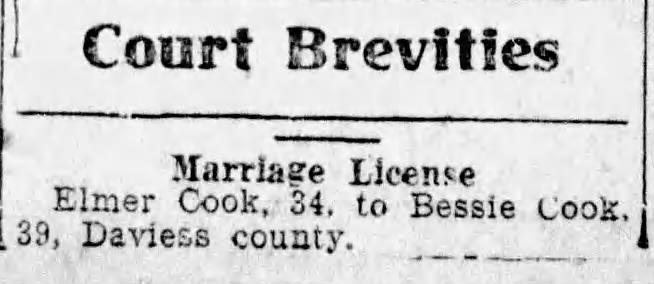
By the time George died on August 8, 1926, Elmer was 34 and still living at George’s home. Bessie was 39. According to the article, Bessie decided to marry Elmer because the neighbors were insisting that they needed to marry—they were probably offended that an unmarried man was living with the widow, and assumed the worst (whether or not their assumptions were correct). Bessie argued that she was unaware that Kentucky law forbade such a marriage, which is understandable. She had probably never thought of Elmer as her son, after all, for he had been an adult, nearly twenty, when she married Elmer’s father. Admittedly, the wedding was a bit hasty. George died in August, and she married Elmer only a month later.

The supposedly incestuous union was quickly annulled following Elmer and Bessie’s arrest. Apparently, they were released from custody once the marriage was annulled and faced no further fines or jail time. Both went on to marry other people.

Elmer married Lula Aldrich sometime around 1928. They had three children, Thomas, born April 24, 1931; Lottie May, born April 26, 1933; and Mary Alice, born March 27, 1935.

Elmer had some run-ins with the law as a young man. He had various problems selling land he inherited from his mother’s family, and was taken to court over it. He was charged with grand larceny in 1916 over the theft of brass fittings from a local company.


But in 1936, he ran into more serious trouble. Elmer was working at a slaughterhouse, and lodging in Owensboro. He got into an altercation with another lodger named Will Warren. Apparently Elmer had a pocketknife and used it to slash Warren on the forehead. Warren had a butcher knife, and stabbed Elmer in the abdomen. News articles stated Elmer’s intestine was perforated, and that surgery was unsuccessful in saving his life. He died on October 16, two days after the stabbing.


In another example of strange legal language, the killer, Warren, was first charged with “malicious cutting”, which seems to downplay the seriousness of the incident. Following Elmer’s death, the charge was changed to murder, but only after Elmer’s brother Arthur swore out a warrant. The killer was eventually able to cut a plea deal for voluntary manslaughter and ended up with a ten-year sentence for Elmer’s death.

Elmer’s family was devastated by his loss. His wife was unable to care for the three children and farmed them out to separate relatives who ended up raising them.


Sources:

News Articles from the Owensboro Messenger, Owensboro, KY. , all accessed on Newspapers.com:

            “Elmer Cook is Held Over to the Grand Jury”. April 23, 1916.

            “Marriage License.” Sept. 24, 1926.

            “Man Marries Step-mother”. Oct. 8, 1926.

            “Divorce Suit.” Oct 9, 1926.

            “Man is Stabbed in Abdomen Here”. Oct. 15, 1936.

            “Butcher Knife Wound is Fatal to Elmer Cook.” Oct. 17, 1936.

            “Knife Victim to Be Buried Today.” Oct. 18, 1936.

Friday, February 28, 2025

The End of the Wilkins Line: 52 Ancestors 2025 Prompt “Siblings”

The Unconventional Wilkins Siblings: Three Brothers, Three Tragedies, and One Lone Sister

Richard R. Wilkins: 1831-1852 (Maternal Second Cousin 3x Removed)
Samuel M. Wilkins: 1839-1915 (Maternal Second Cousin 3x Removed)
Edward Wilkins: 1840-1901 (Maternal Second Cousin 3x Removed)
Eliza Wilkins: 1842-1913 (Maternal Second Cousin 3x Removed)
 

I was intrigued when I ran across the Wilkins family while studying the descendants of the Weir family. Richard, Samuel, Edward and Eliza Wilkins were the children of James Weir Wilkins and Elizabeth Poag. The four siblings seem to have had all the advantages. Their father was a farmer, merchant and school commissioner and seems to have provided the family with a comfortable living. The family seems to have been well-liked; James Wilkins was known locally as Uncle Jim according to one news item I found. Yet all three brothers never married or fathered children, and all met tragic ends. The lone daughter, Eliza, also never married, devoting all her energy to her local church and charitable works. What caused these siblings to choose their unconventional paths?

Richard Wilkins is perhaps the most mysterious of the four siblings due to the lack of information about him. He was the eldest of the Wilkins children, born around 1831. He appears on the 1850 census along with his parents and siblings. He is listed as being 19 years of age, and the occupation entry lists him  as “at school”. This seems odd; he was too old to still be in high school. Perhaps he was attending college, although I have found no records to confirm this hypothesis.

Just two years later, his death appears in the Kentucky state death records. It is an interesting entry. It states that Richard was a single male, age 21, and was born in Madisonville, Kenturcky to James and Eliza Wilkins. This is all routine and expected. However, while all the other deaths reported on the page took place in Kentucky, Richard’s entry states that he died June 1, 1852 “near Fort Kearney Nebraska”. Cause of death is listed as “cholera” and a further notation states that Richard was “en route to California”. 

Richard Wilkins death record

So Richard had left home, perhaps to seek his fortune in the goldfields of California as the 49ers gold rush had begun just three years earlier. Curiously, the local newspaper did not run an obituary or death notice for him, or any articles announcing his decision to move west, despite the family’s prominence in the community. Richard was not buried with the family either; he must have been buried in Nebraska. Why was his death ignored by his family and community?

Second son Samuel Wilkins was born in 1839, and appears on census records in 1860, 1870 and 1880 living with his parents and siblings. As for occupation, Samuel is listed as a “laborer” in 1870 and a scribble that might read “wagoner” in 1860. However, by 1880, at age 41, the census shows he was unemployed, as were his aged father and his remaining siblings. Perhaps Samuel’s loss of employment marked the beginning of mental illness. Samuel died at age 76 on September 25, 1915 from a cerebral hemorrhage while he was a resident at Western State Hospital in Hopkinsville, an institution for the mentally ill. The newspaper notice stated that he had been a patient for twenty years, meaning he was institutionalized around 1895, about a decade after his father’s death.


The final son, Edward, was born in March of 1840. He seems to have never held a job or did any kind of work, but lived off his father’s earnings. Even his Civil War draft record lists “nothing” as his occupation. 

Edward's Civil War draft record

The only census where he lists an occupation was the 1900 census, taken when he was already sixty years old. He claimed he was a “capitalist”, which sounds a little smart-alecky to me. He died at age 61 in Madisonville, Kentucky. The obituary was very interesting, calling him “the most unique character in Hopkins County”. I suspect this was not a compliment. He was described as being “known as one of the handsomest men in the county, and was prominent in social circles, being wealthy and of a good family.”


The article went on to describe how he fell in love and became engaged to a local girl, but she jilted him. “He began to drink heavily. For some time past he had not been in his right mind. He left real estate to the value of $20,000.” Perhaps, like his brother Samuel, Edward suffered from mental illness.

As for the final child, daughter Eliza Wilkins, she never married and never worked, living with her father until his death in 1885, and then living at a home on Sugg and Seminary Streets in Madisonville. The obituary in the local paper described her as a Presbyterian who was “a worker in the church much of the time. When the end came she was ready as indicated by her conversation with friends during her last illness. She did many acts of charity unpretentiously, and had great love for animals, especially those crippled or mistreated.” Another newspaper said she lived “a long and useful life”.


From the description, I surmise that she was very religious and may have been a cat lady or the canine equivalent—at the very least, she was a little eccentric.

So all four of James Weir Wilkins and Elizabeth Poag’s children seem to have struggled to fit into their community. James supported his children for his entire life. Once he died, they seem to have floundered, having failed to launch careers and families of their own. Despite the Wilkins family’s prominence in the town of Madisonville, Kentucky, it appears the Wilkins children were troubled. James Weir Wilkins and his wife Elizabeth Poag were first cousins—their mothers were sisters. Could this close genetic relationship have been part of the problem? Did mental illness run in the family? The Wilkins siblings leave me with many unanswerable questions.  

Sources:

1850, 1860, 1870 and 1880 United States Census. Ancestry.com. https://www.ancestry.com/search/collections/7667/records/39425881?tid=81812584&pid=262650250655&ssrc=pt

Kentucky, U.S., Death Records, 1852-1965. Ancestry.com https://www.ancestry.com/search/collections/1222/records/307132?tid=81812584&pid=262650328964&ssrc=pt

“Four Deaths at Hospital”. Hopkinsville Kentuckian. Hopkinsville, KY. September 28, 1915. Newspapers.com.

U.S., Civil War Draft Registrations Records, 1863-1865. Kentucky. Snd. Class 1. Ancestry.com

“Unique Character of Madisonville Dead.” Courier-Journal. Louisville, KY. May 2, 1901. Newspapers.com.

A Godly Profession: 52 Ancestors 2026 Prompt “A Family Pattern”

  Five of Willis Smith’s Sons Follow Him Into a Life of Faith and Service Willis Smith: 1853-1928 (Maternal Great-Grandfather) Albert Elia...