Sunday, August 29, 2021

Down a Rabbit Hole: Tracing a Robertson Great-Grand-Uncle

Thomas Robertson: 1851-?
Albert Cameron Robertson: 1897-1917


I often make discoveries about ancestors unexpectedly, while looking for someone or something else. I pull one thread, and a whole set of mysteries unravels. It’s a bit like falling down the proverbial rabbit hole into a whole new world. That happened today, while tracing the Robertson branch of the Aird family.

My husband’s grandfather, Harry Aird, was born to James Aird and Jane Ann Robertson Aird. Jane was the child of Hellen Wood and William Robertson; she was born in Dundee, Forfarshire, Scotland on June 30, 1857. Jane had three siblings, Thomas, James and Mary Ann, and today I decided to search for their death dates, as well as any other information about spouses or descendants I might turn up on the way. Thomas and his children proved to be of special interest.

Jane’s eldest brother, Thomas Robertson, was born around 1851, also in Dundee. He appears on the Scottish census records in 1861, living with his parents. But by 1871, now twenty years old, he was living on his own on Millars Wynd in Dundee as a boarder in the home of Charles Marie and family. Thomas was working as a baker, possibly nearby at William Coupar’s bakery at 51 Perth Road, near the University of Dundee.  

Intersection of Millars Wynd and Perth Road, Dundee, early 1900s

Millars Wynd intersected with Perth Road, which was where a 20 year old nurse by the name of Jessie Galletly lived, caring for someone in the Andrew Hendry home at 245 Perth Rd. Since Thomas and Jessie lived and worked in the same small neighborhood, it’s not surprising that they met. They married sometime between the 1871 census and the birth of their first child, Isabella Anderson Robertson, March 6, 1873.

Three other children quickly followed: Helen or Hellen Wood Robertson, born September 1, 1874; Wilhelmina “Nellie” Robertson, born in 1877, and finally Alexander Robertson, born sometime in late 1879 or possibly early 1880. I discovered all four of these children living with their father Thomas in his parents’ home in Dundee on the 1881 census. Also living there were James and Jane Ann Robertson Aird and their newborn, Isabella Aird. But no sign of Jessie. Obviously something had happened to Thomas’ wife, leaving him a widower with four young children. Perhaps Jessie died giving birth to young Alexander.

Census record, Robertsons and Airds 1881
                

By the next census, Thomas had acquired a new wife, Margaret Smith, and the first two of their eventual four sons had been born, Thomas Smith Robertson in 1887, and William Robertson in 1890. Father Thomas was still working as a baker, and the family was living at 10 Peddie Street, just north of Perth Road.

Peddie Street where family lived in 1890s

By the 1901 census, they had moved to 15 Forest Park Road, still in the same Dundee neighborhood near Perth Road where Thomas had first met and married Jessie. Now the family included the two youngest sons, Albert Cameron Robertson, born in July or early August of 1897, and Norman McLeod Robertson, born June 8, 1900. 

Robertson residences over course of 30 years: 1. Forest Park Dr.; 2. Peddie Rd.; 3. Millars Wynd/Perth

Wilhelmina/Nellie was still living at home, now 25 years old and working as a domestic nurse, while her brother Alex, 21, was employed as a drapery warehouseman. Thomas’ two other daughters, Isabella and Helen, had moved out. I have been unable to locate any further records for Isabella; she may have married, died, or moved somewhere unusual. There are a couple possible records for Helen, but nothing verifiable. The two young women essentially disappear.

15 Forest Park in Dundee today

I have found no 1911 census records for Thomas, Margaret or their four sons. They, like Isabella and Helen, might have mysteriously disappeared but for one important record: the military records for young Albert Cameron Robertson.

Albert enlisted in the army on August 5, 1916 at the age of 18 years and four months, joining the 11th Battalion of the Argyll and Sutherland Highlanders, otherwise known as the Princess Louise Regiment, which saw action on the Western Front in Europe with the 9th Scottish Division.

Hatpin for Albert's regiment


Military records show that Albert died April 23, 1917, in the Second Battle of Arras. The British Army suffered 10,000 losses in an attempt to take the high ground near the French city of Arras; Albert was one of those losses.

One of the Argyll & Sutherland battalions in WWI

His army paperwork provided a treasure trove of information. First, he provided two addresses: his family’s home when he enlisted, No. 12 Peddie Street, one building down from where they lived at his birth in Dundee, and the family’s new address in Perthshire, in the Campbells Buildings, a large apartment complex, in the town of Stanley. I’m not sure what caused his family to move there—perhaps his father retired from his bakery job, or lost his job, or perhaps there was some other motivation. But at least I know why I could no longer find them in Dundee.


Albert’s army papers also provided a hint of a rupture between his half-siblings and the rest of the family. He was asked to list all siblings: he wrote he had no sisters, and only three brothers, Thomas, Willie and Norman, all of whom were in the army. Of course in reality he had three half-sisters and a half-brother, but even though there was a section on the form for “Full-blood” and “Half-blood” siblings, he ignored his half-siblings. There’s a story there that, sadly, we’ll never learn.

Albert was awarded the Victory Medal and the British War Medal for his service and ultimate sacrifice in battle. The medals were sent to his father Thomas, who signed for them, so while we have no photos of Thomas, we have his signature from a century ago.


In summary, I failed in my goal for the day: to find death dates and records for Jane Ann Robertson’s siblings. Her oldest brother Thomas’ death date remains a mystery, although I was able to confirm he was still alive in 1918. However, my unsuccessful search for that piece of information led me to some fascinating new discoveries: Thomas’ long-time job as a baker, the decades his family spent in one small neighborhood in Dundee, his two wives and his eight children, and the tragic loss of his young son Albert Cameron Robertson in World War I. After learning so much about Thomas and his family, it’s hard to see the day’s research as a failure!

Now I’ll need to burrow further down my research rabbit hole to find out what happened to Albert’s three soldier siblings: did they make it home from the war or did they die like Albert? Every new discovery always leads to new questions. And who knows—perhaps my research on Thomas Jr., Willie and Norman will lead me to my research Holy Grail: Thomas Robertson’s date and place of death! I can dream!


Sources:

Photo of Millars Wynd and Perth Rd, Dundee.http://www.leisureandculturedundee.com/photopolis/millars-wynd-and-perth-road-dundee

K, British Army World War I Service Records, 1914-1920 for Albert Cameron Robertson. Ancestry.com.

https://www.ancestry.com/imageviewer/collections/1219/images/30974_185764-01093?pId=1651322

Information and photos, Battle of Arras. https://military.wikia.org/wiki/Battle_of_Arras_(1917)

Wednesday, August 25, 2021

Correcting the Record for Louise A Shields: 52 Ancestors Prompt “Changes”

Time for Changes to the Tree and Changes in Family Attitudes

Louise Annie Kinnear to Louise Antoinette Pool: 1872-74 to 1975


According to the tree I had assembled for my husband’s family, his great-granduncle Archibald Shields married a Dutch/Javanese woman by the name of Louise Annie Kinnear. My information on Louise was minimal. I had no birth records or parents’ names for her, and I had no marriage record for Archibald and Louise. The only records I found for Louise were from the period after her marriage—the first record she appears on is the birth record for Archie and Louise’s eldest daughter in 1909. Louise appears only on records as Louise A. Shields—her middle name and maiden name never appear.

So how did I come up with the name Louise Annie Kinnear? I confess, with shame, that I had just copied that maiden name from several other Ancestry trees, including the one managed by my brother-in-law, who is a careful researcher. None of those trees had links to any records that would verify “Annie” or “Kinnear”.

So I shouldn’t have been surprised when I discovered another Ancestry tree that provided a very different name for Louise. That tree, apparently managed by a direct descendant of Archie and Louise Shields, listed her as Louise Antoinette Pool, born in Padang, Sumatra, Dutch East Indies. Despite all these new details, there were no records attached to the tree that would verify the information.

Padang, Sumatra around 1900

I faced a conundrum. I lacked documentation for either maiden name. Should I just assume, since it looked like this new tree was managed by a direct descendant, that he or she had more accurate information, and change my tree to match? I tried searching both names in Ancestry with no result.

I then turned to my old friend Google. And lo and behold, the name Louise Antoinette Pool turned up a match in the archives on the island of Jersey. The Jersey court records include her will. While the will itself cannot be accessed online, the indexed description provides some essential information, reading:

“Will and Testament of Louise Antoinette Shields, widow of Archibald Shields, of Sous Les Arbres, St. Peter’s Valley, St. Peter and formerly of Aintree, College Hill, St. Helier. Dated 25/08/1959. [Includes two closed documents]”


This is verification that Louise’s correct maiden name was Louise Antoinette Pool. I already knew that Archie and Louise had retired to the island of Jersey when he quit managing Alliance Plantation in Suriname. Everything matched up to the data I already had. I quickly made changes to my Ancestry tree, providing correct information and a screenshot of the Jersey Archive index entry.

So what else do we know about Louise? And how much of what we supposedly know is as inaccurate as the surname “Kinnear”?

Archie and Louise apparently married in Suriname around 1907, following the death of Archie’s father Thomas in 1905. I have no information about how or where they met. Their first child, Margaret Sutherland Shields, was born October 13, 1909 in Paramaribo. Their second child was born in January 1912 in Lambeth, London, during one of the family’s regular visits to Great Britain. They named her Euphemia Louise Shields. Their third daughter, Bethia Delphine Shields, was born in 1913 in Paramaribo.

The Shields family on steps of Alliance Plantation house, supposedly taken in 1903, but woman at bottom is Margaret Shields, who only came out after husband's death in 1905. Likely taken around 1907. I believe Louise and Archie are the two people standing. 

The family spent most of their time living at the Alliance Plantation house. They were an attractive family. The girls grew up with their cousins, James Allan Smith and Bethea Elizabeth Smith, the children of Archie’s nephew James Laing Smith. Young James was the same age as Archie’s youngest daughter Bethia, and Bethea Smith was a year younger.

Louise at left with her three daughters, Margeret, Effie, and Bethia. Marguerite Smith and her children James and Bethea at right. Around 1915 or 1916.

Archie and Louise spent some time living on Bay Street in St. Michael, Barbados. At some point, Archie acquired property on Jersey and retired there, although he continued to travel to Suriname until at least the 1950s when the plantation was sold to the Suriname government. It is unclear where Archie and Louise’s daughters were educated.

Archie died on Jersey in 1962 at age 98. Louise died in 1975; she was between 100 and 103 years old, depending on her actual birthdate.

So that comprises the facts about Louise. But what stories and impressions do we have from other family members?

Archie and Louise’s niece, Ruth Shields McNiven, included Louise as a character in a story she wrote in high school about life on Alliance Plantation in Suriname. The way Louise is described is quite unflattering. She blithers on about people coming to tea and the need to roll the tennis courts while Archie is discussing serious problems with the plantation’s workers which eventually erupt into a worker uprising. Louise repeatedly demands that she be allowed to order expensive English dresses to keep up with other women in her and Archie’s social set, and the story ends with her getting her gowns.

Ruth’s description of her many years later was a little kinder, but still indicated that Archie’s extended family weren’t very fond of Louise. She told John and Laurel Aird that when Archie brought his new bride home to Ellangowan, the Shields family home in Scotland, Archie’s mother was upset, wondering why he couldn’t have married a good Scots lassie? Ruth’s further comments on Louise were recorded by Laurel as follows:

“ Aunt Louise was half Javanese. Her father was an officer in the Dutch Army. She was brought up in a convent. Attractive. Lived to be 100 on Isle of Jersey. Much younger than he. She made Uncle Archie jealous by flirting.”

John Aird’s memoirs contain his memories of the Shields family’s assessment of Louise:

“As a matter of fact, Grandpa Shields’ brother Archie married a Javanese woman, who was referred to as Aunt Louise. I once saw a picture of her as a mature woman, from which it was obvious that she would have been very attractive in her youth. Anecdotes about Aunt Louise suggested that she was very conscious of her station and also that the family were careful to make sure that her status did not encroach on their own. She must have had a difficult time of it in some respects. There apparently were some children from that union, who were taken to Scotland when their father retired there, and they lived near London for a time after his death, but the family later lost track of them and no one seemed to know (or to care) what became of them.”

John’s summary is repugnant, and reflects the bigotry of the extended Shields family. It is also inaccurate. John Aird’s grandfather attended his mother’s 100th birthday party in 1937, and Archie and Louise were also in attendance, as is obvious from this portion of John Sutherland Shields’ letter to his family:

“Uncle A. and Aunt Louise came across Monday with the 11 A.M. boat. Dick and I went down to meet them. They are both looking very well; Louise much improved, looking almost younger and stouter than ever and a very healthy color, bright eyes and lots of talk. Aunt B. and E. too are very well.”

So obviously the extended family knew exactly where Archie, Louise and their daughters were, at least during John Shields’ lifetime. Ruth seems to have kept in touch as well, and presumably the Smith cousins, who grew up with Archie and Louise’s daughters, kept in touch with the girls.

But apparently racism kept some of the Shields family from accepting Louise and her daughters as real members of their family. I shudder at John’s casual comment that she was “referred to as Aunt Louise”, as if that were merely a courtesy title granted to a “fancy woman” or something. She WAS their Aunt Louise. And the idea that Archie’s daughters “were taken to Scotland when their father retired there”, implies the family thought they ought to have been left behind in Suriname with their “kind” or something. Louise isn’t even mentioned as having accompanied Archie and their daughters. For goodness sake! They were a family! Of course they moved to Jersey with their father! Families live together!

Aintree, College Hill, St. Helier, Jersey: Louise and Archie's first home on Jersey.

It is just stunning to be faced with the Shields’ family’s bigotry.  It is so disturbing to read that they worried that Louise's ethnicity would drag down their own social standing. John’s phrasing and word choice show he had, likely unintentionally and without awareness, picked up on his extended family’s disdain and repugnance for Archie’s half-caste (I use this phrase only in the context of the time period—it is a horrible way to describe people now, of course) wife and daughters, and channeled it in his writing. I want to emphasize that John never exhibited any sign of racism himself as an adult; he was uniformly kind and accepting of everyone. This reflects another type of “Change”, the theme of this post: the younger generations of the family began, thankfully, to move past the casual bigotry of the early twentieth century.

It would have been fascinating to ask Louise what she thought of Archie’s family and their treatment of her and her daughters. I’m sure it would have been enlightening and disturbing. She deserved better. At least now her real maiden name is in the family tree.


Sources:

https://upload.wikimedia.org/wikipedia/commons/3/3c/COLLECTIE_TROPENMUSEUM_De_Padangrivier_te_Padang_Sumatra%60s_Westkust_TMnr_60003520.jpg

https://catalogue.jerseyheritage.org/collection/Keywords/archive/content.person.name/Shields,%20Louise%20Antoinette,%20n%C3%A9e%20Pool

Memoirs of John Shields Aird: 10 November 1919-09 October 2005. Pg. 28.

Thursday, July 22, 2021

The Ugly Reality of Nineteenth Century City Life: 52 Ancestors 2021 Prompt “In the City”

Fire, Smoke and Soot: 

Life in the City of Coatbridge/Airdrie, Scotland

John Sutherland 1813-1892

Bethia Muir: 1815-1894

Margaret Sutherland Shields, Bruce’s second great grandmother, was born May 25, 1837 in the town of Coatbridge in Lanarkshire, Scotland. Her parents, John Sutherland and his wife Bethia Muir Sutherland, had grown up in the area. The years after Margaret’s birth saw dramatic changes in both the city of Coatbridge and in her parents’ circumstances.

John Sutherland came from humble beginnings and moved up in the world through hard, brutal work in the Coatbridge area. According to information John Sutherland provided on census records, he was born around 1812 or 1813 in either Barony, Old Monkland or Rutherglen, all towns or parishes in Lanarkshire near Glasgow. His father, John Sutherland, was a coalminer. His mother was Annie Jean Smith. He had several siblings.

Old Monkland Parish, 1816

John married Bethia Muir in June, 1834. She was the daughter of Robert Muir and Margaret Anderson Lauder of Old Monkland. She was born October 29, 1815; the birth record states that at the time, her father was working as a weaver.

John Sutherland had followed his father into the mines. The 1841 census lists him as a coal miner, with the family, now including two children, John, 6, and Ann, 2, (Margaret’s whereabouts are unknown. She would have been age 4) living at “Allan’s Place, Langlone” in the Old Monkland parish.

According to the 1851 census, John Sutherland had completely changed careers at some point during the 1840s. In 1851, he supposedly was working as a bookseller—quite a contrast to coal mining. The family, now with six surviving children, was living on Church Street in Old Monkland. I have some doubts about the accuracy of his occupation—could this be a transcription error?-- but the family seems to be moving up in the world a bit.

By 1861, the family’s fortunes were definitely improving. They now lived in a home with a name—The Old Manse in New Monkland, and John’s new occupation was “ironstone centresictor”. I have no idea what a “centresictor” might be, nor does Google or the dictionary. I suspect this is a transcription error—perhaps ironstone contractor? I suspect he was brokering the sale of iron ore to foundries for processing.


I was able to track down photos of the Old Manse. There were two homes by that name, both quite large and grand for the area. The first was torn down around 1870 or shortly thereafter, so I believe the photo of this original home shows the building the Sutherlands called home in 1861, the year Margaret married Thomas Shields.

By 1871, the family had relocated to a home at 60 WellWynd in Airdrie, and John Sutherland was listed as an “iron forge master”, which could indicate he was the owner of the business or at least a manager. According to Ruth McNiven her grandmother Margaret’s family owned a foundry in the town of Airdrie, and were quite wealthy. She said the Shields boys could ride their bicycles around the Sutherland billiard room. As the 1871 census shows Margaret and Thomas Shields and their five young children also living at 60 WellWynd, the Shields boys would have had many opportunities to ride around there.

1858 Airdrie Ordnance Survey Map showing Wellwynd and the Airdrie Foundry

I have tried to find information about the foundry. Histories of the area describe several foundries in and around Airdrie, but the Sutherland name has not turned up in connection with any of them. However, another Ancestry tree that includes the Sutherlands connected the Airdrie Iron Foundry to them, posting the following document, which I believe was a stock share of some sort.


Note that the document has an address, 72 WellWynd, printed at the top. Interestingly, this is just down the street from the Sutherland house. It would make sense that John would live near his business. In addition, the document references a Smith family member. As I mentioned earlier, John Sutherland’s mother was a Smith. Perhaps he was related to the foundry’s owner or previous owner.

An ordnance gazetteer from 1885 has an entry for the Airdrie Iron Foundry, stating it was owned by David Smith. As I have been unable to identify Annie Jean Smith Sutherland’s extended family, I don’t know if David Smith is a relative or not. He may have purchased the foundry from the Sutherlands, as John Sutherland was retired by that point.

Ordnance Gazetteer entry for Airdrie Iron Foundry

So what was this area of Lanarkshire like in the mid to late 1800s? Airdrie lies just outside the larger town of Coatbridge, and both communities were only ten miles from Glasgow, with Old and New Monkland in their midst. The entire area is now part of the greater Glasgow metro area, but in the mid-1800s, they were all still separate communities. Here is a description of Coatbridge in 1846 by Samuel Lewis:

“Coatbridge, a village, in the late quoad sacra parish of Gartsherrie, parish of Old Monkland, Middle ward of county Lanark, l 1/2 mile (NW) from Airdrie, containing 1599 inhabitants. This is a very thriving place, which has more than doubled in extent and population within the last fifteen years, owing to the extension of the iron trade in the district, and to its being in the vicinity of valuable coal-mines; the Dundyvan and Summerlee iron-works in the neighbourhood are conducted on a large scale, and afford employment to a great part of the population. The village is on the road from Airdrie to Glasgow; and the Monkland canal also affords facilities of communication with the adjacent towns. A post-office has been established here, and there is a place of worship for members of the Free Church.”

Here is his description of neighboring Gartsherrie, where the Shields boys attended the Academy:

“Gartsherrie, 2 miles W from Airdrie… is a considerable mining district, in the works connected with which the chief of the population are employed: the ironworks are of great magnitude, and include a number of blast-furnaces for the smelting of the ore. The coal-mine here is also worked on a very extensive scale; there are five strata of coal, between each of which is a stratum of sandstone and shale : the seams of coal vary in thickness from one foot four inches to four feet. The Glasgow and Garnkirk railway, which starts from St. Rollox, in the north-east quarter of the city, joins the Monkland and Kirkintilloch railway at this place. …The church, erected at a cost of £3300, is an elegant structure, with a tower rising to the height of 136 feet, and contains 1500 sittings. Near it is the Academy, erected in 1844, at cost of £2300; and there is a large Sabbath school in connexion with the Establishment.”

From these descriptions we can tell the area had grown quickly due to the coal mining and iron foundry businesses, but the area still had fewer than 10,000 inhabitants. However, for the time period, it qualified as a city. The size of the church alone attests to that—seating for 1500 people! Wow!

As the mining and iron foundry businesses grew, there were impacts on the towns. During the last decades of the 19th century, Airdrie and Coatbridge/New Monkland were hardly garden spots. Here is a description from the 1880s by Francis Groome:

“The Airdrie and Coatbridge district comprises 21 active collieries; and in or about the town are 5 establishments for the pig-iron manufacture—Calder, Carnbroe, Gartsherrie, Langloan, and Summerlee—of whose 41 furnaces 29 were in blast in 1879, when 8 malleable iron-works had 113 puddling furnaces and 19 rolling mills.

“Coatbridge, in its growth, has absorbed, or is still absorbing, a number of outlying suburbs-Langloan, Gartsherrie, High Sunnyside, Coats, Clifton, Drumpellier, Dundyvan, Summerlee, Whifflet, Coatdyke, etc.; and the appearance of the whole, redeemed though it is by some good architectural features, is far more curious than pleasing. Fire, smoke, and soot, with the roar and rattle of machinery, are its leading characteristics; the flames of its furnaces cast on the midnight sky a glow as if of some vast conflagration.”

Summerlee Iron Works with Gartsherrie Burn at left foreground (stream) and Monkland Canal at the right

Another writer describes the town as follows:

"Though Coatbridge is a most interesting seat of industry, it is anything but beautiful. Dense clouds of smoke roll over it incessantly, and impart to all the buildings a peculiarly dingy aspect. A coat of black dust overlies everything, and in a few hours the visitor finds his complexion considerably deteriorated by the flakes of soot which fill the air, and settle on his face.”

The writer goes on to describe the night sky lit with a “lurid glow” by the fires of over 50 blast furnaces belching “great tongues of fire”.

Summerlee Iron Works Coatbridge, with smoky sky

Findlay notes in his History of the Iron and Steel Industry in Scotland:

“The iron industry peaked by about 1871, at which time it employed nearly 40% of the Scottish workforce, and 25% of its steam power. In Coatbridge the ground vibrated from the pounding of steam hammers and a forest of chimneys spewed soot and grit across Coatbridge, which had become the most polluted town in the UK, if not the World. At times it turned day into a night, lit by the blast from the furnaces.”

No matter the size of the Sutherland billiard room during the family’s most prosperous times, the noise, water and air pollution must have made life difficult. It is hard to imagine raising small children in such an environment, especially when the Sutherlands and Shields families lived just a few steps down the street from one of those fire and smoke belching foundries. While they had come up in the world, they were paying a price for their success.

Anderson St. in Airdrie, near the 60 WellWynd house owned by Sutherlands

Perhaps this is why, by the time of the 1881 census, the Sutherlands had moved back to New Monkland, where they were living in the more modestly named “Muirshill Cottage.” John Sutherland’s wife was born a Muir, so perhaps they lived in a Muir-owned property. John was now listed as a “portioner”, which I assume is similar to “pensioner”. He was 68 years old, so was no longer working.

A few years later, the Sutherlands had moved back into Airdrie. The 1891 census finds them living at 2 Inglefield Terrace in Airdrie. John is listed as an 80 year old “retired iron forger”. It appears his second son, William, had taken over the foundry and the house at 60 Wellwynd.

John Sutherland died August 25, 1892 at age 79 or 80. His wife Bethia died April 3, 1894. The iron and coal industries in Scotland and the Coatbridge area went into decline as other areas of Great Britain became more dominant. The skies above Coatbridge and Airdrie are far cleaner today.


Sources:

Ordnance Gazetteer of Scotland, Francis H Groome, 1885

http://www.scottishmining.co.uk/34.html

 A topographical dictionary of Scotland, Samuel Lewis, 1846 http://www.scottishmining.co.uk/34.html

Article titled “History of the Iron and Steel Industry in Scotland” by C. Findlay. Scottish Steelworks History website: https://cfindlay17.wixsite.com/clydebridge/history-of-iron-and-steel-in-scotla

National Library of Scotland ordnance survey maps. https://maps.nls.uk/townplans/coatbridge.html

Thursday, July 15, 2021

Lord Kelvin’s Bright Young Man:52 Ancestors 2021 Prompt “School”

Youngest Graduate of University of Glasgow and Assistant to One of Physics’ Greats

Thomas Shields: 1867-1936


            Great-granduncle Thomas Shields was a scholar extraordinaire, succeeding both as a student and as a college professor. His life story has some fascinating details and some interesting missing pieces.    

Thomas Shields was the second youngest child of Thomas and Margaret Sutherland Shields, and was born June 28, 1867 in New Monkland, Lanarkshire, Scotland. Like his older brothers, he attended Gartsherrie Academy. However, he did not choose to follow in his father’s footsteps as a mechanical engineer. He enrolled at the University of Glasgow and studied electrical engineering and physics.  

Univ of Glasgow in 1880s

According to Ruth McNiven, Thomas became “Lord Kelvin’s bright young man.” Yes, the “degrees Kelvin” guy, the Scottish physicist who, among other achievements, helped develop the second law of thermodynamics; the absolute temperature scale (measured in kelvins); the dynamical theory of heat; the mathematical analysis of electricity and magnetism, including the basic ideas for the electromagnetic theory of light; the geophysical determination of the age of the Earth; and fundamental work in hydrodynamics. That Lord Kelvin.


Ruth was proud of her uncle, noting that Thomas became the youngest graduate of University of Glasgow, a record unbroken for half a century.

I found these claims a little hard to believe, so I set out to investigate them. To my delight, Ruth was telling the truth. 

I was able to locate Thomas’ Graduate Record at the University of Glasgow, and it confirms he received his MA in 1885, which made him only seventeen years old when he graduated. Lord Kelvin was a professor at the University of Glasgow for over fifty years, and 1885 was in the center of that timespan, when Kelvin was already renowned in the field of physics.

As you can see from the University record I found, Thomas held the position of “Assistant to Lord Kelvin” while at the university. Quite amazing!

Univ. of Glasgow Chemistry students and Laboratory Assistants, 1884-1885

By age 23, according to the 1891 Scotland Census, Thomas was working as a “Demonstrator in Physics” and living in Glasgow with some of his siblings. His employer was not listed, but was probably still the University of Glasgow. However, as we can see from his Graduate Record, at some point he moved on to a position as a Lecturer in Technical Electricity at Yorkshire College, Leeds.

However, Thomas moved on from Leeds fairly quickly, and spent part of his career as a Demonstrator in Physics and Lecturer in Electrical Engineering at the Royal Indian Engineering College. The RIEC was a British college of Civil Engineering run by the India Office to train civil engineers for service in the Indian Public Works Department. It was located on the Cooper's Hill estate, near Egham, Surrey. Thomas’ employment there was confirmed by British census data as well as his Graduate Record.

Royal Indian Engineering College where Thomas worked for ten years or so

            Thomas married an Englishwoman named Hilda Finch Paine on August 28, 1897. Hilda and her family lived in Egham at the time of the 1891 census, so it is likely Thomas met her when he took the position at RIEC.

Following their marriage, Thomas and Hilda moved into a house in Egham charmingly called Holly Cottage, and were living there at the time of the 1901 England Census. The census shows that two of their three children had been born by then, Colin, then age two, and infant Hilda. The young couple also had a servant living with them, so they must have been fairly comfortable financially.

1911 Census record for Thomas Shields and family

Sadly, REIC closed in 1906, moving operations to India. Thomas remained in England, but the family moved from Egham to West Byfleet in Surrey, a distance of about ten miles. The 1911 England Census shows them living in The White House in West Byfleet. I believe I have found records of that house, which is on the historical register in England. Here is a photo of the house today.


I have been unable to find any further information about Thomas’ later career. Ruth claimed that he ended up working as a patent attorney—seems an odd change from engineering professor—and had a beautiful home. However, Ruth said, he lived beyond his means for years, and his mother made up the difference. I wonder if there was miscommunication regarding who Ruth was discussing—this doesn’t seem to match with census records for Thomas at all. It seems unlikely that a man in his forties would go back to school to radically switch careers from physics professor to attorney. However, until the 1921 England census records are released in 2022, I will not be able to investigate further.

I wrote about Thomas’ son Colin in a previous post—he was an RAF pilot in World War I and died at 21 in an aircrash. Thomas’ two daughters, Hilda and Cecily, grew up in an era when young ladies rarely attended a university, so they did not follow their father into a science career. Cecily married a military officer, Gustaf “Cherry” Baker. Hilda married Donald McIntyre, a factory manager for several factories in Argentina and Uruguay, so she spent much of her married life abroad before her early death at age 38 in 1938.

Thomas preceded his daughter in death. He died September 19, 1936 at the age of sixty-nine. He left an estate valued at 11,900 pounds. The equivalent value today is 856,800 pounds, which works out to $1.189 million in U.S. currency—a substantial estate.

Probate record for Thomas Shields

I wish someone in the immediate family had been able to talk to Thomas while he was still alive about his university days. What an exciting time to be studying physics, and to be working with a man who made such a broad and lasting impact on the field! I’m sure Thomas had some amazing stories.

Sources:

1884-85 Students and Assistants of Chemical Laboratory, Univ of Glasgow. https://www.gla.ac.uk/schools/chemistry/abouttheschool/history/archivegroupphotos/

Graduate Record and Graduate Bio of Thomas Shields https://www.universitystory.gla.ac.uk/biography/?id=WH16276&type=P

Friday, July 9, 2021

Robert Shields’ Heroic Death: 52 Ancestors 2021 Prompt “Tragedy”

Heroic Death Far From Home

Robert Shields: 1875-1901


            When John and Laurel Aird visited John’s aunt Ruth Shields McNiven several decades ago, they spent time discussing the history of the Shields family. Ruth’s brief summary of her youngest uncle’s life caught my attention: “Robert was a chemist. Died in Burma at 26, in an oil company fire, saving others.”

            A tragedy in two short sentences. So young. So heroic. And sadly, so dead. So what else can we learn about Robert Shields? How did a young Scotsman end up in Burma?

            Robert Shields, youngest in the family, was born to Thomas Shields and Margaret Sutherland Shields in either 1875 or 1876. No one has found a birth record for him yet. He first appears in records in the 1891 census, living with his siblings Thomas and Effie at 12 Kings Crescent in the Cathcart area of Glasgow. He is listed as a “scholar”. Then age sixteen, he may have already been enrolled at the University of Glasgow. That would explain why he was living with Thomas Shields, who was working at the University as a “demonstrator in physics”. Presumably Robert had followed his brothers to Gartsherrie Academy for his pre-university education.

            I have reviewed graduate records from the University of Glasgow, but found none for Robert. I believe that “graduate” records may refer only to advanced degrees, however. It is also possible that Robert could have followed Thomas when he became a lecturer at Yorkshire College in Leeds, and Robert could have completed his degree there. His degree was probably the British equivalent of an undergraduate degree in the field of either chemistry or chemical engineering. I base this hypothesis in part on Ruth’s claim that he was a chemist, in part on another relative’s claim that he was an engineer, and in part due to his employment at an oil refinery, an appropriate job for a chemical engineer.


So why did Robert take a job in Burma? It turns out that Scottish companies were investing in Burma in the late 1800s. Grace’s Guide to British Industrial History notes”

“[In] 1876 David Sime Cargill, after visiting Burma, purchased the Glasgow-based Rangoon Oil Co Ltd, which had failed because the King of Upper Burma was using his monopoly power to overcharge for crude oil found in his territory…Over the next ten years Cargill supported the loss-making refining and distribution activities from his own pocket, to the extent of £100,000.”

Burmah Oil Company fields--early 1900s

The pandaw.com blog further described the history of the Burmese oil fields and refineries:

“Since 1858 there had been a small refinery at Rangoon, using Yenangyaung crude as feedstock and exporting products to Europe and India. By 1871 it was in financial trouble and its assets were bought by a group of Scottish businessmen who registered a new company in Edinburgh, the Rangoon Oil Company…The annexation of Upper Burma in the 1886 Third Anglo-Burma War meant that the whole country, formerly the Kingdom of Ava, was now a part of British India administered locally by a Chief Commissioner in Rangoon.

It was a major milestone in the evolution of Myanmar's petroleum industry, ushering in the modern era. In that same year, 1886, David Cargill, who was the principal shareholder of Rangoon Oil Company, sold it to another Scottish-registered company founded in the same year, Burmah Oil Company, which had technical links back home to the East Midlothian shale-oil industry. Cargill thereby acquired an interest and became Chairman of the new company.

With new deep wells and even the helmet-equipped well-diggers contributing to production growth, Burmah Oil's refinery capacity needed to expand. Its original refinery was at Dunneedaw near Rangoon, but then a second was built at Syriam, south of Rangoon, which in due course became the company's main refinery. Later a pipeline from the oilfields to these refineries was built in 1908.”

Moving machinery at Burmah Oil Co. fields near Rangoon--1910s

With his background in chemistry and/or engineering, Robert would have been a valuable addition to Burmah Oil’s refinery staff. Here is a transcription of a job posting for such a position, showing that the company was looking for responsible, experienced, single Scotsmen.


Photos from the era show large groups of young, male, British employees at the Syriam refinery and in the greater Rangoon area, so he would have had a pleasant ex-patriate lifestyle with plenty of friends. Robert’s father and siblings had set a precedent of working abroad, so I’m sure Robert saw employment in Burma as an attractive opportunity.

Tennis players in Syriam, site of a Burmah Oil refinery. All young British men.

It is unclear at which of the two Rangoon area refineries Robert was employed, nor is it clear how long he had been in Burma before his death. I found no records online regarding his employment. The only record I have found is the death record, stating he died May 8, 1901 in Rangoon. Nor have I found a record of an explosion or fire in Rangoon in May 1901; the accident apparently did not rate a mention in the international press. I don’t know how many people were injured or killed in the refinery fire in addition to Robert, or whether he was successful in saving any others. Laurel and John never asked Ruth how the family found out about his fate or whether there were any other details regarding the fire. I found photos of a similar disaster at a Texas refinery in 1901; the photo below shows how terrifying and devastating a fire at an oil processing facility can be.

Refinery fire in Texas, 1900.

The death record states that Robert is buried in “Rangoon, Bengal, India”. This makes no sense, as Rangoon is in Burma/Myanmar, while Bengal, India is over 1,300 miles away. I am hypothesizing that the office that processed death records for British citizens in the Asian and Indian colonies was located in Bengal, India, and that Robert actually died and was buried in Rangoon. I have been unable to learn the location of his grave.

I wish there was more information about this young man. I also wish there was a photo of him. His death was tragic enough, but having his whole brief life summarized in a couple of quickly forgettable sentences is even more of a tragedy.


Sources:

Rangoon Oil Co. History https://www.gracesguide.co.uk/Rangoon_Oil_Co

https://www.pandaw.com/blog/cruise/history-of-oil-production-in-the-irrawaddy-valley

https://i.pinimg.com/originals/61/1a/6a/611a6aa2fa48393fa3ff19406627e72c.jpg

Photos of Burmah Oil Company oil fields taken by Alfred Knight in 1920s. From family history blog: http://www.hotten.net/open/pages/families/knight/photoalbums/burma/homebuilding.htm#row4

Wednesday, July 7, 2021

A Fashionable Wedding: 52 Ancestors 2021 Prompt “Fashion”

Wedding Write-ups from the 1950s: Fashion-Magazine-Worthy Descriptions

Eleanor Birk Sutton: 1929-Present


            While researching family members, I occasionally run across newspaper write-ups of their weddings. Most are fairly straight-forward: who, when, where, neatly tied up in a single paragraph. But the period from the 1920s through the 1950s produced far more elaborate articles describing the décor, the music and especially the clothing worn by the bride and her attendants. Some of the descriptions were fashion magazine worthy! The wedding write-up for Bruce’s second cousin Eleanor Birk’s wedding to Harry Sutton is the perfect example of one of these fashion-rich news articles, providing descriptions of the dresses worn by the bride, maid of honor, bridesmaids, mothers of the bride and groom, and the bride’s going-away outfit. So many adjectives! So many fabrics! What a delight!

            To provide a little background, Eleanor was the daughter of William F. Birk and Daisy Smith. She was born August 8, 1929 in Daviess County, Kentucky. Eleanor’s mother, Daisy, was Lorene Smith Jandy’s niece, the daughter of Lorene’s eldest brother, James Frampton Smith.

Eleanor Kirk before her marriage

            Eleanor grew up in Owensboro and attended Owensboro High School, followed by time at Gulf Park College in Gulfport Mississippi, a women’s college, and then some time at the University of Kentucky. She may have met her future husband, Harry Shelby Sutton, at the university. While he was also an Owensboro High grad, he graduated eight years ahead of Eleanor, and then spent three years in the Marines during World War II before attending the University of Kentucky for an engineering degree. By the time he was engaged to Eleanor, he was employed by General Electric in Owensboro as an engineer.

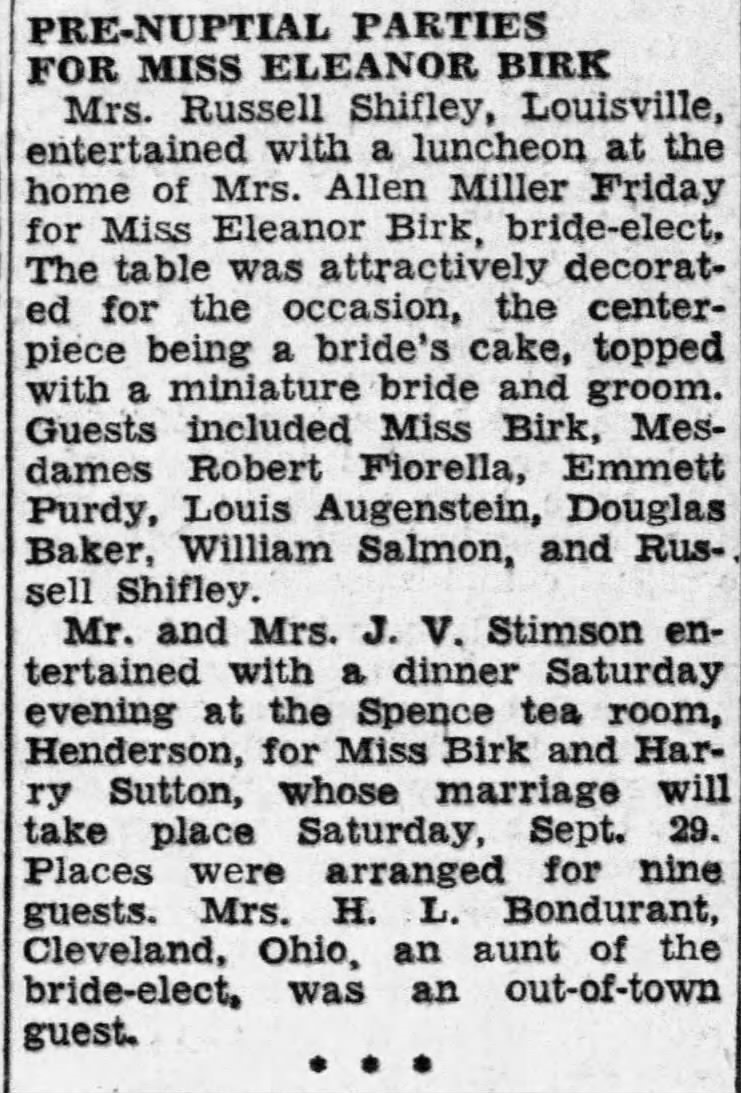
            The Owensboro Messenger newspaper did an excellent job covering the social life of the community. Engagements and weddings received lavish write-ups, and parties and showers honoring brides were also covered. There were several social column items about Eleanor and Harry’s upcoming nuptials before the article that described the main event.


            The descriptions of the dresses follow. The detail makes it easy to imagine how the ladies looked as they came down the aisle:

“The bride…wore an ivory satin wedding gown made with portrait neckline, banded with illusion and seed pearl trim, with fitted basque, long sleeves with points over the hands, and panniered skirt, with long train. Her fingertip veil of illusion was held in place with a half hat with seed trim. She carried a white Bible, topped with a white orchid, and show of stephanotis.”

I have attached a sketch of a 1950s wedding dress that has many of those features—the portrait neck, fitted basque or bodice, the long sleeves coming to a point over the back of the hands, and the full skirt. Eleanor’s skirt would have pouffed out more with the addition of the pannier—a sort of hoop skirt contraption—beneath it. The illustration also features the half-cap with veil, although Eleanor’s veil would have been slightly longer since it was finger-tip length.


“Mrs. Stavis, matron of honor, wore a bronze satin and net dress, the bodice being of satin and skirt of net over taffeta. Her headdress was a bandeau of bronze satin, with mask veil. She carried an arm bouquet of Sunburst roses.”

“The five bridesmaids wore identical dresses to…the matron of honor, and carried arm bouquets of large bronze chrysanthemums.”

Here are two vintage 1950s satin dresses with net skirts that gives an idea of what the bridesmaids dresses may have looked like, but in a bronze color. They must have been striking—bronze would have been a perfect fall shade, especially with the addition of bouquets of lovely fall flowers.  


“The candlelighters…wore aqua faille dresses, in ballerina length, with matching double net capelets.”

“The mother of the bride wore a lilac faille taffeta gown, with bouffant skirt and sweetheart neckline. Her corsage was of violets and tiny rosebuds.”

“The mother of the groom wore a charcoal crepe dress, with black accessories and a white orchid corsage.”

“The grandmother of the bride, Mrs. J. Frampton Smith, wore a black crepe dress, with a beaded lace yoke, matching accessories, and a gardenia corsage.”

“Mrs. Sutton (the bride) for traveling wore a gray two-piece wool suit, with black accessories and a white orchid corsage.”

The poor groom and his attendants received no attention from the reporter; their clothes were apparently unremarkable. This was typical for wedding articles of the era.

My only regret is that we have no photos of what was apparently a very stylish wedding.

Eleanor and Harry Sutton’s marriage lasted an amazing 65 years, until Harry’s death in 2016. The couple were the parents of two sons and had numerous grandchildren.


Sources:

Newspapers.com – Owensboro KY Messenger-Inquirer - 30 Sep 1951 - Page 20, https://www.newspapers.com/clip/72365152/eleanor-birk-wedding/?xid=637&_ga=2.44693089.479190359.1625623453-557144419.1581562418

A Godly Profession: 52 Ancestors 2026 Prompt “A Family Pattern”

  Five of Willis Smith’s Sons Follow Him Into a Life of Faith and Service Willis Smith: 1853-1928 (Maternal Great-Grandfather) Albert Elia...