Monday, February 21, 2022

The Secret “Homicide”: 52 Ancestors 2022 Prompt “Shadows”

The Mysterious Death of Cornelia Sears

Cornelia Florence Sears: 1889-1920


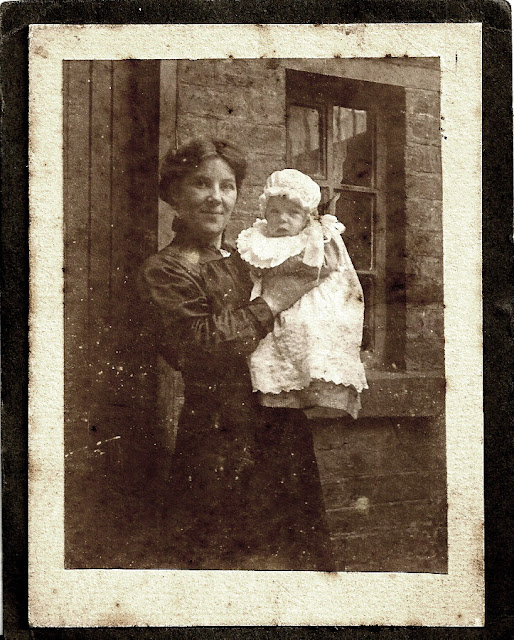
Records of a person’s life are often limited. A researcher might unearth a birth record, a death record or burial record, and a few census records or perhaps a marriage record, with little else to flesh out the years between those few dates and milestones. There’s no official record of the details that comprise a rich, well-lived life, or an accounting of the difficulties of a sorrowful life. Sometimes the few records that exist hint at a dark history, something that has been buried, leaving a mere shadow to indicate that a tragedy occurred. Such is the case with Cornelia Florence Sears. What happened to this young woman to cut her life short at the age of thirty-one? What is missing from the records?

How are we related?

Cornelia was born on May 12, 1889 to Samuel Owens Sears and Sarah “Sallie” Smith Sears. She was the seventh of their eight children, and grew up on their farm in Muhlenberg County, Kentucky. By 1910, she was living at home with her parents, her younger sister Maggie, and her brother Edward. But in the years that followed, her last siblings married and moved away. Edward left farming to become a mechanic, and Maggie married a local farmer named Andrew Glenn. Cornelia was left alone with her aging parents—on the 1920 census, recorded on January 15, 1920, she is listed as 31 years old, with no job and no husband—only her 70 year old father and 69 year old mother as companions.

Less than six months later, Cornelia was dead. The cause of death listed on the death certificate was a shock: “Homicide, by firearms”. Apparently the shot was fired on June 3, and Cornelia lingered for two days, dying June 5, 1920.


I immediately turned to Newspapers.com and to Google. A murder in rural Kentucky in 1920 would have been big news in the state. But I found nothing. Not a single mention of Cornelia, of a murder or attempted murder, no obituary or funeral notice—nothing! That is beyond peculiar.


I found Cornelia’s grave on Findagrave. The headstone lists her by her nickname of “Noma” Sears. The inscription at the base of the stone reads: “How Desolate Our Home Bereft of Thee.” Obviously her parents were broken-hearted.


So what happened to Cornelia Florence Sears? Why did her community remain silent after such a tragedy? I wonder if the “homicide” might have been either a horrible accident or, even more tragic, a self-inflicted homicide—suicide. There is no record of an arrest, or mention in the area newspapers of a crime. So perhaps there was no actual crime.

Whatever the real story behind the gunshot that took Cornelia’s life, it will remain hidden in the shadows, as her family and friends apparently wished.

Sunday, February 20, 2022

The Aunt Who Loved Azaleas: 52 Ancestors 2022 Prompt “Flowers”

Aunt Gail, Azaleas, and Adorable Photos

Gail Smith Jandy Livingstone: 1934-2011


I just ran across three adorable photos of Aunt Gail as a little child last week. They prompted memories of her, including her love of the azaleas she and Phil planted on their Davidisonville, Maryland property. So when I saw the prompt “Flowers”, I immediately thought of Gail.

Gail held by her mother Lorene on August 31, 1936--age 2

Gail Smith Jandy was born to Edward and Lorene Smith Jandy on June 30, 1934 in Detroit, Michigan. She was their second child, seven years younger than her older sister Laurel. At age sixteen, she accompanied her parents to Ethiopia when her father was stationed at the embassy for a year, and attended the Beirut College for Women for another year afterwards. These experiences sparked a lifelong love of travel.

After getting her degree in library science, she worked for the Air Force on several bases around the world, establishing school libraries, before returning to the United States where she worked as a high school librarian for two Maryland school districts.

She married Philip Livingstone in 1970, and helped to raise his two daughters, Caren and Cathy. She died of cancer on March 11, 2011. Gail’s obituary speaks of her love for gardening and azaleas:

“As a resident of Davidsonville her avid interest in flower gardening evolved into establishing a garden including more than 200 azalea plants which were the focus of her annual "Azalea Walk" for friends. She derived a lot of pleasure through participation in the informal Perennial Garden Club established by local gardener friends.”

Gail in Detroit in 1936--almost 2 years old

These delightful photos of Gail as a young child show the same joyful spirit and energy that I remember her exhibiting as an adult.

Gail--April 1940. Age 5 years and 10 months


Saturday, February 19, 2022

Three Sisters in Paradise: 52 Ancestors 2022 Prompt “Sisters”

The Brief Lives of Three Sisters: Daughters of Elijah and Nancy Smith

Mary Smith: 1843-1843

Susan L. Smith: 1855-1857

Esther C. Smith: 1862-1862


The brief lives of three of my husband’s great-grandaunts are a sad reminder of how difficult childbirth and raising children could be in the mid-nineteenth century. Elijah Smith and his wife Nancy Vanlandingham Weir Smith had at least eleven children between 1840 and 1863. Yet only six, including my husband’s great-grandfather Willis Smith, survived infancy. To add further pain, Elijah and Nancy lost another son, Elias, in the Civil War at only age twenty. Life in rural Kentucky was harsh.

Mary Smith was Elijah and Nancy’s first daughter, born August 15, 1843. She died just two days later on August 17, 1843. Her headstone in the Weir Family Cemetery in Paradise, Kentucky, made of dark grey stone, is the easiest to read: “Mary, Infant Daughter, EE & Nancy Smith” and then the dates of her birth and death.


Susan’s headstone is made of white marble, which of course is now severely eroded from acid rain over the last century. There was some sort of symbol at the top, then her name and middle initial, and the dates of her life. She was a Christmas season baby, born December 22, 1855, and died just four months after her first birthday on April 8, 1857. What a heartbreak for her parents!


The final little sister was Esther C. Smith, born June 16, 1862. Her older brother Elias had just been killed fighting for the Confederacy at the Battle of Shiloh on April 29, so poor Elijah and Nancy probably saw this little girl as a potential source of comfort after such a horrible loss. Instead, Esther died just four and a half months after her birth on November 5, 1862. Her white marble headstone, while mostly unreadable in the Findagrave photo, is decorated with a dove symbol—appropriate for a little girl buried in Paradise.


There is so little left to remind us that these three little girls even existed. All I can find are those three headstones in the Weir family cemetery in Paradise, Kentucky. What did the name of this community mean to its residents? Was it a beautiful place that reminded them of paradise? Or was it a difficult place that held only the promise of paradise after death?

Now, sadly, the town of Paradise is gone, destroyed by a company strip-mining for coal, and from down-wind pollution from the TVA coal-fired power plant built nearby. The Weir cemetery is surrounded by devastated land as this aerial photo shows. A sad end for Willis Smith’s three little sisters.


Sources: 

Findagrave photos. 

Monday, February 7, 2022

“Pinning” and Courtship in the 1940s: 52 Ancestors 2022 Prompt “Courting”

 Pinned but Not Pinned Down: Laurel and John’s Courtship


John Aird’s memoir describes his first impressions of his future wife, Laurel Jandy.

“…Laurie was animated, responsive, always ready to laugh, and interested in almost any subject. Immediately I was interested in her…One thing troubled me, however. She was wearing a small pin on her sweater which might very well have been a gift from another man. It could even mean that she was engaged. I was loath to interpret it that way, but I knew that this was what such ornaments usually signified. I was careful not to find out.” (page 338)

Laurel Jandy in 1945

College courtship in the 1940s had an extra step between “going steady” and getting engaged: getting “pinned” or “lavaliered”. Originally this practice arose in fraternities—the fraternity pin was given to a serious girlfriend, who would wear it on her sweater or blouse from then on as a visual symbol, like an engagement ring, of the existence of the relationship. In other words, the pin was a public symbol that the young lady was “taken”.

A researcher from Southern Illinois University, Jon Gorgosz,  wrote a paper on the practice of pinning. He quotes a college newspaper article from the early 1950s that noted, “Pinning is the most serious step so far. It is a step nearer to the engagement which ultimately leads to marriage. Not only is a frat pin one more symbol of love and possession, but it also has a deeper and a more lasting feeling attached to it. To be pinned is not to be taken lightly. It brings the couple nearer to marriage, a home and a family” (Gothard, 1957). The researcher goes on to state, “This passage decisively illustrates the connection between pinning and the movement towards marriage and separates the practice from “young love” rituals, such as “going steady.”

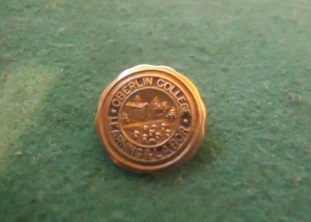
However, Oberlin College did not have fraternities on campus. What sort of pin was being exchanged there? Did the College itself provide class pins of some sort that male students pressed into service? Were there pins related to the dormitory or house the men lived in? My attempts to find out what sort of pin was used in Laurel’s case have failed. Online searches of Oberlin’s archives have produced no hits thus far. Obviously since John was aware of the symbolic meaning of the pin, the practice was commonly used at Oberlin, despite the lack of records about it. 

Perhaps a pin like this Oberlin one?

John discovered later that Laurel’s pin was from a student or graduate named Ed Ryder who was not on campus that year, and that Laurel considered herself nearly engaged to Ed. Her friends took her growing relationship with John badly, making pointed jokes and critical comments. One remarked that Laurel was at least “white and 21”, referring to the phrase “free, white and 21” that signaled a woman was available, and implying that Laurel was not free.

A courting-appropriate cover on this 1940s Oberlin College bulletin?

Despite Laurel’s attachment to Ed, and despite the disapproval of other students, John and Laurel fell in love and married. John never presented her with a pin—he went straight to an engagement ring and wedding ring to publicly demonstrate his commitment.

We have Laurel’s letters from her college years. I have only read a few thus far. I hope to find the ones that describe Ed presenting the pin to her, and see how she interpreted the meaning of being pinned. It’s a fascinating window into college courtship in the 1940s.

Sources:

https://opensiuc.lib.siu.edu/cgi/viewcontent.cgi?article=1001&context=esh_2014 Gorgosz, Jon E., "The Practice of Pinning and Its Production of Gendered, Idealized Images for Women on College Campus in the 1940s, 50s and 60s" (2014). 2014. Paper 2.http://opensiuc.lib.siu.edu/esh_2014/2

Memoirs of John Shields Aird, 10 Nov 1919-09 Oct 2005. Pgs. 338-339.

Tuesday, January 18, 2022

Finding an Out-of-Print Book: 52 Ancestors 2022 Prompt “Favorite Find”

Edward Jandy’s Book: Tracking Down a Copy of Charles Horton Cooley: His Life and His Social Theory

Edward Jandy: 1899-1980


While cleaning out my mother-in-law Laurel Jandy Aird’s house following her death a few years ago, we found a copy of a book written by her father in 1942. I had never heard about Edward Jandy’s book, a biography titled Charles Horton Cooley: His Life and His Social Theory, and was curious. Another family member kept Laurel’s copy, so when we returned home, I decided to acquire a copy so our children would have their great-grandfather’s book. After some searching online, I found a copy that was in good condition for a reasonable price of $14.99. I bought it, and it has become a favorite find.


I think you can learn a lot about a person by reading their written thoughts. I have barely started reading Prof. Jandy’s book, but it has already been illuminating. In addition, finding the book prompted me to do further research on Edward, and I turned up a research paper and several book reviews on sociology texts and books that he penned. I am just beginning to understand the breadth of his research and interests.

To provide some background, Ed was born on May 22, 1899 to parents Emanuel Jandesjek and Emily Tomsche Jandesjek. The couple had immigrated to Chicago from the Bohemian area of Czechoslovakia. Ed was the second youngest of their nine children.

Money was tight for the family, particularly after Emanuel died in 1905 when Ed was only five years old. Most of Ed’s siblings left school early to start working. However, Ed chose to put himself through college—not an easy task in the early twentieth century. He began his education at Blackburn College in Carlinville, Illinois, and completed his undergraduate degree at Coe College in Iowa. From there he pursued graduate degrees in psychology and sociology at the University of Michigan, beginning in 1927. At some point, he "Americanized" his surname from "Jandesjek" to "Jandy". 

At Michigan, he studied under Charles Horton Cooley and was greatly influenced by him.  Following Cooley's death, Ed sought and received permission to write the biography and analysis of Cooley’s sociological theory as his PhD thesis. The book was published in 1942 and reprinted in 1969.

Dr. Edward Jandy, November 1940

It is interesting to read a non-fiction book from the 1940s, noting how the genre has changed over eighty years. The language in Ed's book is a bit more flowery and more abstruse than I am used to. Of course this is partly due to the fact that the book was written as a PhD thesis with an intended audience of fellow sociology PhDs rather than the general public. The most striking difference was Ed’s insertion of his own feelings and reactions in the text using the awkward reference “the author” or "this writer"; there was less emphasis on trying to make the text appear factual and without bias. Ed’s personality and attitudes were much more apparent than in non-fiction and biographies of current times.

Title page of Ed's book, held open with an Ethiopian knife Ed brought home from his time working in Ethiopia later in his career. 

The book also shows me how the field of sociology has changed. During the period Ed was pursuing his doctorate, the leaders in the field were trying to shift the emphasis in the field of social science away from the humanities toward a true science. From what I have gleaned thus far, Ed was drawn initially to the “social” or humanities side of the field, having come from an undergrad study of philosophy. Cooley was opposed to the push for a more scientific approach, which Ed agreed with when he first started his doctorate. However, by the time he was writing his doctoral thesis, he saw the benefits of using statistics and a more scientific approach to sociological problems. The following passage from the book’s final chapter demonstrates this change in his views:

“We come now to one of the most crucial problems that Cooley ever posed. It has to do with the making of sociology into a philosophy as well as an art. However ardent a disciple the writer may be, he is frankly of the opinion that here Cooley raised as many, or more problems than he solved…[T]here are some dangers in making sociology a philosophy and also an art…a sociology of this sort may find itself spread over a tremendous surface with corresponding thinness. It may find itself speculating to no definite purpose…”

“In our time, sociology can no longer afford to be autobiographical nor can sociologists presume that their own lives afford materials enough for the science they need.”

“If the author appears to be mildly skeptical and critical of some of Cooley’s views on science and method, it is hardly because he is not basically sympathetic with them. It is rather because he feels seriously that this whole problem of sociology also taking on the role of philosophy and art is one so crucial that it needs to be worked out much more adequately than is has been up to now.”

I am so glad to have found a copy of Ed’s book and to be able to understand what drew him to the field of sociology. I look forward to learning more about his work and research.

Sources:

Charles Horton Cooley: His Life and His Social Theory. Edward C. Jandy. Copyright 1942. Reprint 1969, Octogon Books, New York.

Sunday, January 9, 2022

Out-of-Wedlock Questions: 52 Ancestors 2022 Prompt “Curious”

1904 Out-of-Wedlock Birth: Curious About Social Consequences in Edwardian Era Scotland

Margaret Fleming Spence Sutherland: 1884-1973


While researching Sutherland ancestors, I ran across information from another user’s tree on Ancestry that suggested a collateral ancestor gave birth out of wedlock over a century ago in Airdrie, Scotland. I was curious, which led me to do further research on the young woman. After all, during that era in America, out-of-wedlock births were considered very shameful; the mothers were often sent away and were encouraged to give up the child. However, that didn’t happen to this young woman and her child. And that makes the story even more intriguing.

Margaret Fleming Spence Sutherland, my husband’s first cousin three times removed, was born to Thomas Sutherland and Jeanie Spence Sutherland on June 26, 1884.  She was Thomas and Jeanie’s fifth child, named after their third child, Margaret Fleming Sutherland, who had died at age two in 1882.

Margaret’s father Thomas died at age 50 on June 25, 1904. Margaret had her twentieth birthday just one day later. It must have been a horrible time for the entire family; the chief breadwinner was suddenly gone just as the family was trying to deal with another family problem. At the time of Thomas’ death, Margaret was pregnant and unmarried. Her son, William Muir Sutherland, was born just a few weeks later on August 4, 1904. Another Sutherland descendant posted little William’s birth record obtained from a Scotland government website, and it clearly shows the only parent was Margaret, and the baby was given her surname.

William Muir Sutherland's birth record

Birth records from the era show that premarital sex was not exactly uncommon; many first babies made their appearance just five or six months after a marriage. However, marriage was the usual and expected outcome to a surprise pregnancy. So what happened to Margaret? She was nineteen when she conceived—not really a child anymore, particularly in that era. Was her lover already married? Did he die? Move away? Refuse to “do the right thing”? Was she a rape victim? We will never know the answer.

We will also never know what social consequences Margaret and her family faced. She continued living at home with her widowed mother and some of her siblings, so at least her family stood by her. The family relocated from a handsome home on Victoria Place to 140 South Nimmo Street in Airdrie, but that was likely due to the change in financial circumstances following Thomas’ death. It appears Margaret raised her son at the Nimmo Street location. Other trees report 1911 census data (records that I have been unable to find) that show Margaret, her mother and sister Bethia living there. I found a photo of Margaret and her young son on Ancestry; she looks happy and the baby, dressed all in white, appears to be a healthy little fellow.


It is hard to tell if Margaret’s illegitimate son affected her marriage and employment prospects. She didn’t marry until age 31, when young William had just turned 11 years old. However, that is only two years older than her sisters Marion and Jeanie, who married at 29. Two of Margaret’s brothers chose to emigrate to the United States, one sister never married, and the third brother remained in Scotland. Were any of their choices in life impacted by the societal reaction to Margaret’s unwed motherhood? Or was that irrelevant in how the community viewed the family members?

I briefly researched illegitimacy in turn-of-the-century Scotland. A paper by Dr. Janet Greenlees noted that Scotland had higher rates of illegitimacy than other areas of the British Isles, and that families tended to help support the unwed mother and her child and absorb them into the family unit. This matches with Margaret’s experiences. 


Margaret’s husband, Robert Hutcheson, was a 35-year old engine fitter from Airdrie, so he was involved in the same industry as Margaret’s father and brothers. Did she meet him through family connections? Margaret was listed only as “spinster” on the marriage record, so she wasn’t employed at the time of her marriage. Her address was still South Nimmo Street.

Margaret and Robert Hutcheson had three sons: Robert, born in 1917; Thomas, born in 1919, and William George, born in 1924. Robert Hutcheson seems to have had a good relationship with his stepson William Muir Sutherland, who went by the name “Roy” as he grew older. Robert served as a witness at Roy’s wedding on July 12, 1934. Roy married a young woman named Janet Watson, and he was working as a concrete mixer at the time. Roy and Janet spent their lives and raised their family near Airdrie. It does not appear that illegitimacy had a negative effect on Roy’s life, although it is impossible to know for certain.


Margaret was widowed at age 61. She lived in Airdrie until her death on May 23, 1973 at the age of 88.

Margaret in later years

My curiosity about Margaret’s situation wasn’t really satisfied, but the bare facts of her life show that she did a decent job raising her son, and that despite the stigma of unwed motherhood during the Edwardian period, she was able to marry and form a family. Those facts leave me with hope that her life was happy and that she and her family didn’t suffer cruelty from others because of her circumstances.

Sources:

Unmarried Motherhood in Scotland during the Twentieth Century: Mother and Baby Homes. Dr Janet Greenlees, Centre for the Social History of Health and Healthcare. Nov. 2015. https://assets.gov.ie/118666/9b40ab74-fdc1-4852-a2f0-0fb419f3df52.pdf


Wedding Road Trip: 52 Ancestors 2022 Prompt “Road Trip”

Thomas Sutherland: 1891-1946
A “Gretna Green” Wedding


I had heard other genealogists talk about American “Gretna Greens”—towns just across state borders that were popular wedding sites for eloping couples either due to lax rules for obtaining wedding licenses or immediate issuance of licenses. Those genealogists suggested that when a wedding record can’t be found in the expected community or state, that you look for a record across state lines. Until I started researching my husband’s first cousin-three-times-removed, Thomas Sutherland, I had never found a Gretna Green marriage in our families’ trees.

Thomas Sutherland was born March 6, 1891 in Coatbridge, Scotland to parents Thomas Sutherland and Jeanie Spence Sutherland. He was the eighth of their nine children (the sixth to survive past the age of two).

Thomas’ father Thomas was an iron forgeman working in the family forge business in Airdrie. He died at the young age of 50 when Thomas was only thirteen years old. Perhaps finances were tight after his father’s death, for five years later in 1909, Thomas’ eldest brother John and wife emigrated to the United States, settling in Detroit. Three years later, Thomas decided to join his brother in America, setting sail on the ship Cassandra in April 1912. He landed in St. John’s, New Brunswick on April 30, 1912, stating on the passenger arrival form that he was headed to Detroit, presumably to stay with John Spence Sutherland. According to information provided on his naturalization documents, he traveled by train from New Brunswick to Detroit.

Thomas' arrival in New Brunswick

Thomas must not have enjoyed Detroit or perhaps wanted independence from his brother, for he quickly relocated to Pennsylvania. On his World War I draft card, Thomas states that he was working as a millwright for the McKay Chain Company in McKees Rock, Pennsylvania, and he was living at 746 Thomson Avenue. He was drafted into the army, serving as a mechanic in the Seventh Division Transportation Company from Dec. 5, 1917 to July 30, 1919, with one year of his service spent in Europe.


Upon returning to McKees Rock after the war, Thomas returned to his job at McKay Chain, and rented a room at the home of Herman and Pauline Schuette, where he appears on the 1920 census. The Schuettes’ divorced daughter Catherine Hough and Catherine’s eleven-year-old daughter also resided in the home. Thomas and Catherine were both 28 years old and probably spent a lot of time together. Apparently familiarity turned to love, for on July 6, 1921, the couple married in Youngstown, Ohio. (See Naturalization Papers)


But why Youngstown? The location confused me. At first I thought Thomas might have changed jobs and moved to Youngstown, but there was no evidence of that; he was still employed by McKay Chain at the time of the 1930 census, where he appears living with his wife Catherine and stepdaughter. There was no indication that Catherine Schuette Hough had any connection to the town either. The towns were about 65 miles apart. Why would they choose to get married there? I suddenly realized that they might have eloped—as a divorcee, Catherine might have preferred a quick wedding, and her first wedding was also performed in Ohio. I decided to do some Googling to see if there was any mention of Youngstown being a “Gretna Green” for Pennsylvanians.

To my delight, I found a wonderful You Tube presentation sponsored by the Mahoning Valley Historical Society and the Tyler History Center in Youngstown called “Bites and Bits of History: Youngstown as a Gretna Green”. The speaker and researcher, Roslyn Torella, explained that Ohio became a popular wedding spot for Pennsylvanians because Pennsylvania required that both the bride and groom be at least 21 years of age, while Ohio permitted 18 year olds to marry. A veritable marriage industry grew up in Youngstown, which became known as the “Marrying City.” Most couples arrived by train, and cabbies were good at identifying prospective couples, and would drive them to the license office at the courthouse, and then to a minister who would give the cabbie a kickback from the marriage fee. Two ministers, the “Marrying Parsons” of Youngstown, married 12,000 couples over a fifteen year period!

The “Gretna Green” industry came to a halt in late 1910, when an Ohio judge enforced Ohio laws requiring wedding licenses be issued only to brides who were residents of the county issuing the license. The courthouse in Youngstown then began turning away Pennsylvania couples.

So how did Thomas and Catherine manage to get married in Youngstown in 1921 when neither of them were residents of Mahoning County? Perhaps Catherine produced her original marriage license from her first marriage to Percy Hough in 1907, which claimed she was a resident of Mahoning County (and also claimed she was 18 even though she was only 16 at the time). On that certificate, she said she was born in what looks like “Louisville, OH” although records suggest she was born and raised in Pennsylvania. Or perhaps she just lied on the license in 1921 and made up an address in Mahoning County that she claimed as her residence. I can’t find Thomas and Catherine’s license or marriage record online, so can only speculate about how they managed to marry.

Sadly, Thomas and Catherine’s marriage didn’t last. While he claimed they were still married when he filed his naturalization papers in 1934, Catherine, now calling herself Pauline, had already married again around 1931 to an Anthony Woolman. She had a daughter with him named Jessica who was three years old in 1935 when they made the newspapers after having seen a suspected murderer. She filed for divorce from Woolman in April of 1943, stating in court that she married him in 1930 after divorcing her “first” husband. Presumably she means poor Thomas, but he was of course her second husband.


Thomas also eventually remarried. At age 55, he married Florence Sweet on March 11, 1946. The marriage record is rather interesting. He states he had never been married before, conveniently forgetting his nine-year marriage to Catherine/Pauline. He also swears he has no communicable disease. Florence states that she is a widow—as far as I can tell, she was a several-times-divorced woman, who most recently had gone by the name Florence Nagel, her third husband’s surname. In addition, both Thomas and Florence list the same home address, so were either both boarders in the same home, or were living together before the marriage.


Shockingly, Thomas is dead just months later at a Veterans hospital. The death certificate also contains some interesting information. The VA doctor reported that Thomas died from cerebral arteriosclerosis caused by “syphilis tertiary” and “acute and chronic cystitis”. Syphilis tertiary refers to the third phase of syphilis, which is neurosyphilis. So Thomas was untruthful in his marriage license when he said he had no communicable disease. The death certificate also stated that he had been under the doctor’s care in the Veterans hospital for these conditions from March 19, 1946 until the date of death on August 28, 1946. That means he sought treatment for third stage syphilis eight days after marrying Florence.


Did Florence know about his condition when she married him? He must have been in poor shape, after all. Perhaps the marriage was a practical arrangement, guaranteeing that she would care for him until death in return for inheriting his estate. Or perhaps he suffered a stroke or something shortly after the marriage that brought his condition to light.

Thomas was buried in the Union Dale Cemetery in Pittsburgh. His headstone shows the dates of his WWI military service.


Gretna Green elopements often sound very romantic, but in reality very few impulsive marriages are successful or lasting. Poor Thomas Sutherland may have thought he’d found the perfect partner in Catherine Schuette Hough, but like so many road-trip weddings, Thomas and Catherine’s journey together was a short one.  

Sources:

Divorce Court Double Play: Woman and Daughter Apply on Same Day. Pittsburgh Post-Gazette, Pittsburgh PA, 23 Apr 1943. Page 13. Accessed on Newspapers.com https://www.newspapers.com/clip/92181952/catherine-pauline-schuette-sutherland/

Headstone photo by Rob and Debi Felton, Findagrave. https://www.findagrave.com/memorial/99022523/thomas-sutherland

Naturalization record from Ancestry.com: https://www.ancestry.com/imageviewer/collections/2717/images/47295_302022005557_1077-00540?pId=696092

Death Certificate from Ancestry.com: https://www.ancestry.com/imageviewer/collections/5164/images/42410_2421401696_0668-02910?pId=6382158

A Godly Profession: 52 Ancestors 2026 Prompt “A Family Pattern”

  Five of Willis Smith’s Sons Follow Him Into a Life of Faith and Service Willis Smith: 1853-1928 (Maternal Great-Grandfather) Albert Elia...