Sunday, April 27, 2025

Bat Chit Crazy Life of Thomas Cook: 52 Ancestors 2025 Prompt “Institutions”

Tumultuous Homelife Leads to Prison and a Grim Night on an Arizona Cliff

Thomas Joseph Cook: 1929-1957 (Maternal Third Cousin 2x Removed)


While researching Elmer Cook for my previous post, I reviewed records for his children, including his son Thomas Joseph Cook. I discovered that Thomas’ life was cut even shorter than his father’s and was equally troubled, including a stint in an institution: a prison.

Thomas was born April 24, 1929 in McLean County, Kentucky, to parents Elmer Cook and Lula Aldrige. Following his father’s murder in 1936 when Thomas was seven, Thomas’ mother was unable to keep the children together. She separated them and sent them to live with various relatives. Thomas’ sister Lottie May was sent to live with Elmer’s cousin Otis and was eventually adopted by him and his wife. The youngest child, Mary Alice, was adopted by a family named Weatherford. Thomas was sent to live with Tennie Aldrige, his grandmother. He appears in her Owensboro household in the 1940 census, although she has reported him as her nephew rather than her grandson.

Thomas apparently moved to California at some point and ended up in prison. The 1950 census finds him as an inmate at San Quentin, a state prison near San Rafael, California. I have been unable to find any news articles that explain his crime, and it is unclear how long he was institutionalized.  

1950 Census for San Quentin Prison showing Thomas Cook of Kentucky as an inmate.

He ended up in Arizona after his release, working for a guano mine on the rim of the Grand Canyon. U.S. Guano Corp. began mining bat guano from a large cave above the canyon. Guano was used for fertilizer, and erroneous estimates claimed there were hundreds of thousands of dollars of guano in the cave. A tram was built across the Grand Canyon to transport the guano, and miners were hired to dig and sweep up the guano from the cave. The mine barely operated three or four years before closing down due to unprofitability.

Historical Marker at U.S. Guano Corp. site. Photo courtesy Wikimedia Commons.

In the wee hours of Christmas Eve 1957, Thomas somehow fell off the cliff near the tram loading area. He plunged 125 feet, landing on a ledge where fellow employees and sheriff’s department officers recovered his body.


The incident was reported in the local newspaper rather matter-of-factly, but it must have been a little murkier than the article suggested. The death certificate was not signed until January 3, ten days after Thomas’ death. The cause of death reads:

“Coroners Jury Verdict: Injuries sustained in an accidental fall off of the cliff near the upper tower at the Bat-Chit U.S. Guano Cave.”


Further down on the certificate, it notes time of death was 12:10 a.m. (after midnight) and that the death occurred “not while at work”. Thomas’ job position was listed as “mechanic” so he wasn’t one of the miners actually digging up the guano. Still, there would have been questions about why Thomas was at the cliff edge long after the workday was over, enough questions that the death was brought before a coroner’s jury to rule out foul play or even suicide.

View of cliff edge by tram area, the approximate area Thomas fell from. Photo Wikimedia Commons.

On a lighter note, I loved that the location of the death was “Bat Chit”—probably a humorous nickname for the site of a cave full of bat you-know-what. And Bat Chit Crazy sums up Thomas’ short and tragic life.


Following his death, his body was returned to Owensboro for burial, and Thomas was buried in Brushy Fork Cemetery where his grandfather George Edward “Ned” Cook is buried. Thomas’ obituary lists his mother’s address at the time of his death as Kingman, Arizona, which was the town nearest the guano mine. Perhaps he had been living with his mother after he was released from San Quentin.


Sources:

Photo of Guano Point Mine Ruins, Grand Canyon, AZ. https://commons.wikimedia.org/wiki/File:Guano_Point,_Grand_Canyon,_AZ,_USA_(9536784300).jpg

“Grand Canyon Fall Fatal to Worker”. Arizona Daily Star, Tucson, Arizona. Dec. 25, 1957.

Thomas Cook Death Certificate. Ancestry.com. Arizona, U.S., Death Records, 1887-1968 [database on-line]. Lehi, UT, USA: Ancestry.com Operations, Inc., 2016.

“Former Owensboroan Killed in Fall in Arizona”. Owensboro Messenger Inquirer. Owensboro, Kentucky. Jan. 8, 1958.

Changing Definition of Incest: 52 Ancestors 2025 Prompt “Language”

Elmer Cook’s Non-Incestuous “Incestuous” Marriage

Elmer Cook: 1892-1936 (Maternal Second Cousin 3x Removed)
 

Ancestry Pro had flagged some of the people on my tree as lacking sources, so I set out to fix some of them, including second cousin Elmer Cook. When I started reviewing hints for Elmer, in addition to finding proper sources for his birth and death dates, I found some eye-opening news articles about his life. I was especially shocked to read that he was arrested for incest in Kentucky in October 1926. But the more I read, the more confused I became. The supposed incest described in the news article is no longer considered incestuous at all! Has the word changed meaning, or is legal language simply different than common usage?


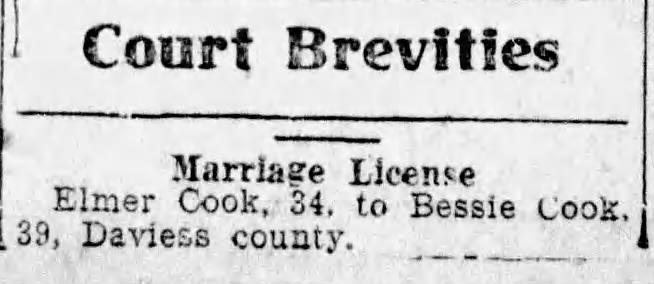
So what did Elmer Cook do that landed him in jail? He married his father’s widow—a woman unrelated to him except by marriage. This hardly meets the current definition of incest, which involves sexual contact between close blood relatives. However, the Kentucky statutes still include stepparent and stepchild relationships under the incest statute, which reads as follows:

530.020 Incest.

(1) A person is guilty of incest when he or she has sexual intercourse or deviate sexual intercourse, as defined in KRS 510.010, with a person whom he or she knows to be his or her parent, child, grandparent, grandchild, great-grandparent, great-grandchild, uncle, aunt, nephew, niece, brother, sister, first cousin, ancestor, or descendant. The relationships referred to herein include blood relationships of either the whole or half blood without regard to legitimacy, relationship of parent and child by adoption, relationship of stepparent and stepchild, and relationship of step-grandparent and step-grandchild.

Apparently several other states have similar definitions. I can certainly see how a stepparent relationship with a much younger stepchild partner could be considered an imbalance of power and sexual grooming and thus be a criminal act, but that hardly applied in the case of Elmer and his stepmother, who were both in their thirties when arrested. So obviously, the legal definition of incest can be quite different than what the layman understands is incestuous.

So how did Elmer get into this situation?

Elmer Cook was born January 12, 1892 to parents George “Ned” Cook and Arra “Airry” Moseley. He was the third of their four children. Airry died when Elmer was only two years old, and Elmer’s father went on to marry two other women, Mary Addie Farrell and Bessie Arnold. George married Bessie April 26, 1912. George was 54, and Bessie was only 23. They went on to have seven children over the fourteen years of their marriage; these children were Elmer’s half-siblings.


By the time George died on August 8, 1926, Elmer was 34 and still living at George’s home. Bessie was 39. According to the article, Bessie decided to marry Elmer because the neighbors were insisting that they needed to marry—they were probably offended that an unmarried man was living with the widow, and assumed the worst (whether or not their assumptions were correct). Bessie argued that she was unaware that Kentucky law forbade such a marriage, which is understandable. She had probably never thought of Elmer as her son, after all, for he had been an adult, nearly twenty, when she married Elmer’s father. Admittedly, the wedding was a bit hasty. George died in August, and she married Elmer only a month later.

The supposedly incestuous union was quickly annulled following Elmer and Bessie’s arrest. Apparently, they were released from custody once the marriage was annulled and faced no further fines or jail time. Both went on to marry other people.

Elmer married Lula Aldrich sometime around 1928. They had three children, Thomas, born April 24, 1931; Lottie May, born April 26, 1933; and Mary Alice, born March 27, 1935.

Elmer had some run-ins with the law as a young man. He had various problems selling land he inherited from his mother’s family, and was taken to court over it. He was charged with grand larceny in 1916 over the theft of brass fittings from a local company.


But in 1936, he ran into more serious trouble. Elmer was working at a slaughterhouse, and lodging in Owensboro. He got into an altercation with another lodger named Will Warren. Apparently Elmer had a pocketknife and used it to slash Warren on the forehead. Warren had a butcher knife, and stabbed Elmer in the abdomen. News articles stated Elmer’s intestine was perforated, and that surgery was unsuccessful in saving his life. He died on October 16, two days after the stabbing.


In another example of strange legal language, the killer, Warren, was first charged with “malicious cutting”, which seems to downplay the seriousness of the incident. Following Elmer’s death, the charge was changed to murder, but only after Elmer’s brother Arthur swore out a warrant. The killer was eventually able to cut a plea deal for voluntary manslaughter and ended up with a ten-year sentence for Elmer’s death.

Elmer’s family was devastated by his loss. His wife was unable to care for the three children and farmed them out to separate relatives who ended up raising them.


Sources:

News Articles from the Owensboro Messenger, Owensboro, KY. , all accessed on Newspapers.com:

            “Elmer Cook is Held Over to the Grand Jury”. April 23, 1916.

            “Marriage License.” Sept. 24, 1926.

            “Man Marries Step-mother”. Oct. 8, 1926.

            “Divorce Suit.” Oct 9, 1926.

            “Man is Stabbed in Abdomen Here”. Oct. 15, 1936.

            “Butcher Knife Wound is Fatal to Elmer Cook.” Oct. 17, 1936.

            “Knife Victim to Be Buried Today.” Oct. 18, 1936.

Friday, February 28, 2025

The End of the Wilkins Line: 52 Ancestors 2025 Prompt “Siblings”

The Unconventional Wilkins Siblings: Three Brothers, Three Tragedies, and One Lone Sister

Richard R. Wilkins: 1831-1852 (Maternal Second Cousin 3x Removed)
Samuel M. Wilkins: 1839-1915 (Maternal Second Cousin 3x Removed)
Edward Wilkins: 1840-1901 (Maternal Second Cousin 3x Removed)
Eliza Wilkins: 1842-1913 (Maternal Second Cousin 3x Removed)
 

I was intrigued when I ran across the Wilkins family while studying the descendants of the Weir family. Richard, Samuel, Edward and Eliza Wilkins were the children of James Weir Wilkins and Elizabeth Poag. The four siblings seem to have had all the advantages. Their father was a farmer, merchant and school commissioner and seems to have provided the family with a comfortable living. The family seems to have been well-liked; James Wilkins was known locally as Uncle Jim according to one news item I found. Yet all three brothers never married or fathered children, and all met tragic ends. The lone daughter, Eliza, also never married, devoting all her energy to her local church and charitable works. What caused these siblings to choose their unconventional paths?

Richard Wilkins is perhaps the most mysterious of the four siblings due to the lack of information about him. He was the eldest of the Wilkins children, born around 1831. He appears on the 1850 census along with his parents and siblings. He is listed as being 19 years of age, and the occupation entry lists him  as “at school”. This seems odd; he was too old to still be in high school. Perhaps he was attending college, although I have found no records to confirm this hypothesis.

Just two years later, his death appears in the Kentucky state death records. It is an interesting entry. It states that Richard was a single male, age 21, and was born in Madisonville, Kenturcky to James and Eliza Wilkins. This is all routine and expected. However, while all the other deaths reported on the page took place in Kentucky, Richard’s entry states that he died June 1, 1852 “near Fort Kearney Nebraska”. Cause of death is listed as “cholera” and a further notation states that Richard was “en route to California”. 

Richard Wilkins death record

So Richard had left home, perhaps to seek his fortune in the goldfields of California as the 49ers gold rush had begun just three years earlier. Curiously, the local newspaper did not run an obituary or death notice for him, or any articles announcing his decision to move west, despite the family’s prominence in the community. Richard was not buried with the family either; he must have been buried in Nebraska. Why was his death ignored by his family and community?

Second son Samuel Wilkins was born in 1839, and appears on census records in 1860, 1870 and 1880 living with his parents and siblings. As for occupation, Samuel is listed as a “laborer” in 1870 and a scribble that might read “wagoner” in 1860. However, by 1880, at age 41, the census shows he was unemployed, as were his aged father and his remaining siblings. Perhaps Samuel’s loss of employment marked the beginning of mental illness. Samuel died at age 76 on September 25, 1915 from a cerebral hemorrhage while he was a resident at Western State Hospital in Hopkinsville, an institution for the mentally ill. The newspaper notice stated that he had been a patient for twenty years, meaning he was institutionalized around 1895, about a decade after his father’s death.


The final son, Edward, was born in March of 1840. He seems to have never held a job or did any kind of work, but lived off his father’s earnings. Even his Civil War draft record lists “nothing” as his occupation. 

Edward's Civil War draft record

The only census where he lists an occupation was the 1900 census, taken when he was already sixty years old. He claimed he was a “capitalist”, which sounds a little smart-alecky to me. He died at age 61 in Madisonville, Kentucky. The obituary was very interesting, calling him “the most unique character in Hopkins County”. I suspect this was not a compliment. He was described as being “known as one of the handsomest men in the county, and was prominent in social circles, being wealthy and of a good family.”


The article went on to describe how he fell in love and became engaged to a local girl, but she jilted him. “He began to drink heavily. For some time past he had not been in his right mind. He left real estate to the value of $20,000.” Perhaps, like his brother Samuel, Edward suffered from mental illness.

As for the final child, daughter Eliza Wilkins, she never married and never worked, living with her father until his death in 1885, and then living at a home on Sugg and Seminary Streets in Madisonville. The obituary in the local paper described her as a Presbyterian who was “a worker in the church much of the time. When the end came she was ready as indicated by her conversation with friends during her last illness. She did many acts of charity unpretentiously, and had great love for animals, especially those crippled or mistreated.” Another newspaper said she lived “a long and useful life”.


From the description, I surmise that she was very religious and may have been a cat lady or the canine equivalent—at the very least, she was a little eccentric.

So all four of James Weir Wilkins and Elizabeth Poag’s children seem to have struggled to fit into their community. James supported his children for his entire life. Once he died, they seem to have floundered, having failed to launch careers and families of their own. Despite the Wilkins family’s prominence in the town of Madisonville, Kentucky, it appears the Wilkins children were troubled. James Weir Wilkins and his wife Elizabeth Poag were first cousins—their mothers were sisters. Could this close genetic relationship have been part of the problem? Did mental illness run in the family? The Wilkins siblings leave me with many unanswerable questions.  

Sources:

1850, 1860, 1870 and 1880 United States Census. Ancestry.com. https://www.ancestry.com/search/collections/7667/records/39425881?tid=81812584&pid=262650250655&ssrc=pt

Kentucky, U.S., Death Records, 1852-1965. Ancestry.com https://www.ancestry.com/search/collections/1222/records/307132?tid=81812584&pid=262650328964&ssrc=pt

“Four Deaths at Hospital”. Hopkinsville Kentuckian. Hopkinsville, KY. September 28, 1915. Newspapers.com.

U.S., Civil War Draft Registrations Records, 1863-1865. Kentucky. Snd. Class 1. Ancestry.com

“Unique Character of Madisonville Dead.” Courier-Journal. Louisville, KY. May 2, 1901. Newspapers.com.

Sunday, February 9, 2025

Laurel’s 1940’s Letters Home from Oberlin College: 52 Ancestors 2025 Prompt “Letters and Diaries”

A Glimpse of War-time College Life Through the Eyes of Laurel Jandy

Laurel Emily Jandy: 1926-2016 (Mother)


When my mother-in-law, Laurel Jandy Aird, died in 2016, the family gathered at her house to sort through the contents to prepare the house for sale and to divide up family photos, heirlooms and assorted memorabilia. My husband and I ended up taking home a marvelous treasure-trove of family letters, including vividly detailed letters his mother sent home from college. 


Laurel attended Oberlin College in Oberlin, Ohio in the early 1940s during World War II. Her letters paint an amazing picture of the campus during the war years. She describes little incidents and makes brief references that send me searching Google for explanations. What my husband and I learned in school as “history” was right there on campus—Laurel was a part of it. My understanding of the World War II era is enriched with every letter I read.

Laurel in 1944

What sort of topics am I learning about? How about Japanese internment? While I have visited the Manzanar historic site in California and knew the basics about the United States’ shameful treatment of its Japanese-American citizens, I realized I had a lot more to learn when I ran across a passage in one of Laurel’s letters.

Laurel mentions turning down a dance invitation from a young man named Sada, “a Japanese from a relocation center.” Apparently the government enjoyed sugarcoating reality with euphemisms in the 1940s as much as they do today. We now call sites like Manzanar internment camps—relocation sounds as if the Japanese confined there were refugees, not loyal American citizens who had been ripped from their homes, jobs and businesses, shipped to these remote, ill-equipped camps, and subjected to prejudice and cruelty.

Laurel didn’t seem to share the prejudice of the era, remarking that Sada was “unusually fine looking and a fairly good dancer” and that she had ridden to college with him on the same bus. She explains that she just didn’t feel like attending a formal dance that night, preferring to catch up on her own interests, and she had turned down two other invitations by other young men earlier.

I was fascinated, not having known that some internees were allowed to attend college. I started researching and found an Oberlin Alumni magazine article about the war-era Japanese students, which included a list of all the students.

I discovered that Sada’s full name was Sadayoshi Omoto. He was born on Bainbridge Island near Seattle, and he was sent to Manzanar with his family in June of 1942.  Sada was one of over forty Nisei students Oberlin had enrolled during the war. The war office had ordered West Coast colleges and universities to deny admission to interned Japanese Americans, apparently believing they would use their education to somehow attack the homeland or provide assistance to Japan. Some of those West Coast college presidents and administrators were appalled and tried to find places for their students elsewhere. After all, these young men and women were Nisei, the first generation born in America—native-born citizens in other words. Oberlin’s president stepped up when contacted by an administrator at the University of Washington, enrolling 17 Nisei in 1942 alone.

Oberlin’s alumni magazine published an article in Fall 2013 describing recent research conducted by history majors on the campus’ experiences with Nisei students. The undergraduates interviewed several surviving Nisei students, and reviewed college and city records to prepare their papers. According to their research, the city of Oberlin vowed to welcome and embrace the students, with the Oberlin News-Tribune editorializing that,

“We do not believe there are any Oberlin citizens who are so lacking in common humanity, or whose patriotism is of such an empty, bombastic variety as would allow them to adopt the attitude of Parkville’s mayor.” (Explanatory note: Parkville, Missouri had rejected students who tried to enroll in a college there.) “If so, they surely do not deserve the name of Oberlin, and we wish them elsewhere.”

1940s postcard of Oberlin College Men's Dormitory

The college itself was so welcoming that within a month of arriving, a Japanese transfer student named Kenji Okuda was elected student body president, attracting national media attention, resulting in AP, UPI and Time Magazine articles.

After the war, most of the Nisei students left Oberlin to complete their degrees at their original West Coast universities, but several students stayed and became alumni. Laurel’s classmate, Sada Omoto, had served in the war as a linguist before enrolling at Oberlin. He graduated from Oberlin in 1949 with a BA in art, marrying a woman he met there. Omoto remained in Ohio, completing a Ph.D. in Art History at Ohio State University. Over the next 40 years, he taught American and Asian art at several Midwest universities, becoming tenured at Michigan State, where he taught for 30 years and served as department chair.  He and his two wives raised four children, and he remained in the area following retirement. He continued creating art and organizing art exhibits until his death at age 90 in 2013.

Sada Omoto

I found Sada Omoto’s story fascinating. Without that paragraph in Laurel’s letter home that week, I would never have known about Oberlin’s choice to take in Nisei students and would never have learned about Omoto’s life after Oberlin.

I am so grateful that Laurel wrote these amazing letters, that she saved them for over sixty years, and that we chose to keep them following her death. I will continue to read the letters and keep researching things she talks about. I also plan to scan the letters and share them with all of Laurel’s grandchildren so that they too can have history brought to life through her life and experiences.

Sources:

Laurel Aird letters. Family collection.

Oberlin Vouches for Them”. Oberlin Magazine. Fall 2013 issue. https://issuu.com/oberlin/docs/oberlin_alumni_magazine_-_fall_2013

Oberlin Magazine. Winter 2014 issue. Obituary for Sadayoshi Omoto, Class of 1949. https://issuu.com/oberlin/docs/13110201

Bainbridge Island Japanese American Community media, including video clips of an interview with Sada Omoto. https://bijac.org/artwork/memorial-on-bainbridge-island-sada-omoto-oh0095/

Obituary for Sada Omoto. https://www.collegeart.org/news/2013/08/21/sadayoshi-sada-omoto-in-memoriam/

“Islander, Teacher and Artist Sadayoshi Omoto Passes Away. Richard D. Oxley. Bainbridge Island Review. Mar 13, 2013. https://www.bainbridgereview.com/news/islander-teacher-and-artist-sadayoshi-omoto-passes-away/

Wednesday, January 15, 2025

The Cowboy-Fiddler: 52 Ancestors 2025 Prompt “Nickname”


Intriguing Shirt-tail Relative with an Occupational Nickname

Robert Hargrave: 1859-1923 (Maternal Grand-Aunt’s Stepson)


I was researching a Smith family descendant by the name of Serelda Hargrave Potts, and ran across a news item that mentioned her daughter, Julia Potts Coe and Julia’s cousin Nellie. The item went on to note that Julia and Nellie “are nieces of Nymphia Carillo Hargrave and Robert Hargrave, violinist, and granddaughters of Robert Hargrave, inventor, who came to California from Texas in a covered wagon train.” My research on poor Serelda was abandoned for a delightful trip down a Hargrave rabbit hole. A violinist married to a woman named Nymphia? I had to know more.

Robert Hargrave, the violinist, was Serelda’s half-sibling, born in 1859, ten years after Serelda was born. Alas, Robert is what my grandmother used to call a “shirt-tail relation”, meaning he’s rather distantly connected to the family, and not even necessarily by blood. That’s the case with Robert. Serelda’s mother was the Smith descendant, not her father, Robert Sr. So Robert Sr.’s son Robert by his second wife was not a blood relation to my husband’s family.

Photo of Robert Hargrave with his violin

Still, Robert sounded fascinating. As I poked around on Ancestry, trying to pin down exactly how he fit in the Smith family line, I ran across another gem of a newspaper item:


The “Cowboy Fiddler”? Now that is a wild nickname! I found Robert on census forms from 1880, 1900 and 1910. Each time he states he is a music teacher, presumably a violin instructor. But apparently by 1920, teaching music was no longer paying the bills, so he had branched out into tending cattle herds on ranches outside San Diego. He was sixty years old, no longer a young man by that point, so he must have been a little desperate.

But despite his circumstances, he had obviously continued to perform. The “Cowboy Fiddler”—I imagine him playing jaunty tunes by a campfire or in a bunkhouse to the applause of his coworkers.

It appears Robert “Cowboy Fiddler” Hargrave died on March 31, 1923, just three years after this news item was published. He was sixty-five years old. He and wife Nellie had several children. Sadly, I did not find a record of a wife named Nymphia, unless, of course, Nellie was a nickname for Nymphia. That’s a rabbit hole I will not pursue!

Sources:

Cowboy Fiddler news item. The Daily Times Advocate. Escondido, California. January 14, 1920 issue. https://www.newspapers.com/article/daily-times-advocate-the-cowboy-fiddler/163112544/

“Mrs. Durand is Guest During Celebration”. San Bernardino County Sun. San Bernardino, California. November 23, 1938 issue. https://www.newspapers.com/image/49170018/?article=52604465-1eb2-4097-9a7a-51a6ee02419a&xid


Friday, January 10, 2025

Harry Aird’s WWI Service: 52 Ancestors 2025 Prompt “Surprise”

A Funny Draft Card Leads to Serious Service for Grandpa Harry

Henry “Harry” Aird: 1886-1966 (Paternal Grandfather)

While I knew my father-in-law John Aird had served in the Army in World War II, I hadn’t been aware that his father, Henry “Harry” Aird, had also been in the Army, serving his adopted country in World War I. An Ancestry hint first led me to Harry’s amusing draft card, and from there to a few records verifying his service.

John Aird, left, in WWII uniform, with his father Harry Aird, who served in WWI

Harry Aird was born in Dundee, Scotland, on September 16, 1886, to parents James Aird and Jane Ann Robertson. He was the fourth of their seven children. Following his father’s death in 1908, Harry decided to emigrate to the United States. His older brother, William, had already emigrated in 1906 with his wife and young children, and had settled in the Detroit area. Harry followed his brother to Detroit in 1910, and found a job as a hardware salesman.

When America began preparations for entry into World War I, men across the country were ordered to register for the draft. Harry complied. His draft card, dated June 5, 1917, stated that Harry was single, worked as a salesman for Bostwick Braun Company based in Toledo, Ohio and said he was a naturalized citizen. The second page noted that he had blue eyes, brown hair and was tall in build.


But the real kicker on the draft card is Harry’s response to Question No. 12 at the bottom of the first page, which reads: “Do you claim exemption from draft (specify grounds)?” The few times I have seen this question filled out, it mentioned disabilities, like a weak heart, lung problems or missing fingers or leg and foot issues. The second type of response usually dealt with being the sole support of aged and sick parents or of minor children.


But Harry gave a very unique response. The draft board representative wrote that Harry “does not want to go.”

Obviously the Army didn’t think Harry’s lack of enthusiasm was grounds for exemption. He seems to have been quickly drafted into the Army. His exact service dates are unclear from the records I have seen. He was discharged in 1919. The article below lists him among the Detroit veterans who need to pick up their official discharge paperwork, and his Fold 3 service record lists his discharge as February 1919.


The final little puzzle piece involves Harry’s naturalization as a U. S. citizen. I found a naturalization index card in his military records. I am not sure if that index card indicates that the army merely reviewed his naturalization status, or if he took advantage of the military’s offer of expedited naturalization for any immigrant who served in the war.


Harry had only lived in the U. S. for six years when he filled out his draft card. Since in 1910 naturalization required five years of continuous residence at the minimum, unless Harry started the naturalization process right away, he might not have been fully naturalized by the time he was drafted. I have placed a request with the National Archives to try to get Harry’s service record. Perhaps that will help to shed light on his military service and naturalization.

Interestingly, just four days after Harry completed his draft board interview and draft card, he married Mary Shields. The marriage record shows a Pastor Christopher Burnett performed the ceremony, and their witnesses were their siblings James Aird and Margaret Shields. 


Did Harry know he was about to be drafted and wanted to get married before he shipped out? Did he hope the marriage would prevent his being drafted? Or was the wedding already planned, and not wanting to leave his soon-to-be bride led to him telling the draft board that he didn’t “want to go”?

Harry Aird died November 6, 1966, so I will never be able to get answers to many of my questions. I will continue to search for Harry’s military records, although the National Archives responded to my request by stating that most of the service records from World War I were destroyed by fire years ago. At least Harry’s surprising response to why he should be exempt from service has survived.  

Sources:

Fold3, US, Index to Naturalizations of World War I Soldiers, 1918 (https://www.fold3.com/publication/107/us-naturalization-index-wwi-soldiers-1918 : accessed Jan 9, 2025), database and images, https://www.fold3.com/publication/107/us-naturalization-index-wwi-soldiers-1918

U. S. Veterans Administration Master Index entry for Harry Aird. https://www.ancestry.com/search/collections/61861/records/670316?tid=81812584&pid=78014052183&ssrc=pt

Marriage Record for Harry Aird and Mary Shields. https://www.ancestry.com/imageviewer/collections/9093/images/41326_342329-00147?pId=460439

United States, Selective Service System. World War I Selective Service System Draft Registration Cards, 1917-1918. Washington, D.C.: National Archives and Records Administration. M1509, 4,582 rolls. Imaged from Family History Library microfilm.https://www.ancestry.com/imageviewer/collections/6482/images/005257979_03790?pId=18134121

Sunday, January 5, 2025

The Lengthy Rap Sheet of Albert Wing: 52 Ancestors 2025 Prompt “Legal Troubles”

Double Murderer, Thief and Prison Escapee: The Worst of the Wild Wing Brothers

Albert E. “Burt” Wing: 1860-Aft. 1920 (Maternal Second Cousin 3x Removed)


I wrote about the Wing brothers in two previous posts, but I saved the worst of the brothers for last. Albert Wing was the youngest of the six Wing brothers, but he had the longest and most varied criminal career of the “bad” brothers in the family.

Albert Wing was born February 24, 1860, to parents Samuel Morrison Wing and Emily M. Weir. His mother died just a few weeks after his birth, and his father, feeling unable to care for the infant, sent him to be raised by Samuel’s unmarried sisters in Greenville, Kentucky. While Albert’s brothers all attended college and law school, I have found no records that indicate Albert sought a degree or trained for a profession. Instead, he seems to have continued to live with his aunts (see the census record below) with no occupation. In later years, he was a gambler.


Albert seems to have been impulsive and dangerous from an early age. He first appears in the press in a brief note in the Crittendon Press’s November 18, 1879 issue:


Albert was only nineteen at the time of this shooting. There is no indication that he faced any legal consequences for this crime. Other articles about Albert’s brother Charles state that Albert attacked and injured one of Charles’ political opponents a year later. Albert may have briefly left the area to avoid prosecution, or his influential family may have interceded to protect him.

However, protecting Albert did him no favors. Just three years later, he committed murder. He was involved with a woman who seems to have been working as a prostitute, despite being the daughter of a well-respected judge. The woman was married and the mother of two children, but she had abandoned her family and had been supporting herself as a prostitute when she wasn’t living with Albert. She was entertaining a man named Joe Glenn when Albert burst in on them and in an apparent fit of jealousy, shot Glenn twice in the head. He tried to tell the police he was acting in self-defense and that Glenn had pulled the gun on him, but Albert’s paramour, variously called Essie Davis and Mrs. Reno, as well as her maiden name of Miriam Eaves, told the police that Albert—who she claimed to have never met before-- shot Glenn deliberately. Ms. Davis/Reno/Eaves quickly recanted, supporting Albert’s story—did Albert’s family intercede to persuade her? Did Albert reach out to her from jail? Or did she just regret throwing her lover under the proverbial bus?

An article about the Glenn murder in the Memphis Daily Appeal noted: “It is said that this is Wing’s second man; that he killed his first man in Kentucky some time ago.” It is unclear whether this is a reference to the political dispute attack in 1880-- the details of which are murky but don’t seem to have ended in death-- or if there was yet another violent incident in Albert’s past.

Albert was released on bond a few months after the murder, and immediately got re-arrested after threatening women at a house of ill repute where his lover Essie/Miriam was working. The house’s madam persuaded the police to release Albert yet again.

Albert finally went to trial for the Glenn murder in March of 1884. Essie Davis/Miriam Eaves’ testimony supported his claims of self-defense, and included her admission that “she visited Wing in the jail and gave him food and money, and after he was released he lived with her for a short time.” The jury was out several days before returning a verdict of guilty of second degree murder. Albert only received a ten-year sentence. To my shock, the press and Albert seemed surprised by the supposed severity of the verdict. They may have been expecting him to be acquitted based on his self-defense claim. However, a mob had rioted recently in Cincinnati in protest of a light charge and sentence in a murder case there, and the press suggested that the St. Louis jury may have feared a similar reaction if they let Albert off too lightly.

Albert’s special treatment continued even in jail.  He only had to serve six years of the ten-year sentence. He was pardoned by the governor of Missouri in April 1890, around the same time as Essie Davis nearly died from an overdose of morphine. She had, amazingly, spent a few years in a convent after Albert went to prison, but when she left the convent, she returned to her old life of prostitution and drug use.

Despite their past and present problems, Albert and Miriam married in April 1892. A later newspaper article provided lurid details of the wedding and their life together:

“Albert Wing and Miriam Reno were suddenly married in Greenville last May at midnight. The next morning, in the presence of a number of witnesses, both swore to a strange and brutal marriage contract. The husband vowed that should ever his newly-made wife be untrue to him he would kill her with the best and most fatal instrument he had at hand.

At the same time the wife swore hat should her husband ever return to his life of drunkenness, that she would put a sudden end to it. Neither party kept rigidly to the threatening nuptial vows….

After four months of married life at Greenville, the wife left her husband and went to Louisville. The husband followed, and after considerable notoriety, the depraved couple went to Myrtie Edwards’ unlawful house at 732 Green Street. Three weeks ago the wife was installed a regular inmate of the house.

732 Green Street in Louisville twenty years later--Myrtie Edwards "unlawful house" and the scene of Miriam's murder

Wing himself remained in the city, and did nothing but gamble and allow himself to be supported by the proceeds of his wife’s shame. Both husband and wife seemed to have forgotten their marriage contract.”

Albert and Miriam got into some sort of argument at the “unlawful house” on the night of November 1, 1892. Albert stabbed Miriam six times, and then fled out the window while the other prostitutes attempted to break into the locked room. The women found Miriam taking her last breaths.


They testified at the inquest two days later, providing lurid details about Albert and Miriam’s relationship. They referred to Miriam as “Kitty”. Lillie Roberts stated:

“Kitty told me her history…and said that she did not doubt but that Albert would kill her, but she would stick to him, because she loved him, and she did not believe that a woman could love but once. She often told me and the presence of the girls at the house that he was a dangerous man, and that if any one ever had trouble with him it would be well for that person to look out, for Albert would surely kill him. I think that both of them were ‘crooked.’ When he did not get money, she would. He would often leave the house without a cent and come back in a few minutes with money. I do not think that he was gone long enough to win this money by gambling. I do not know how he got it unless by robbery. Albert and Kitty would disappear every once and a while for days at a time and I have understood that they ‘worked’ the Indian towns not long ago when the races were going on there. It was told to me that she would manage to get to her room some man who had money and the Albert would make him pay to keep the matter secret…”

Headline from November 11, 1892 Louisville Courier


Albert was finally captured on November 9, 1892 in New Orleans. He was sent back to Kentucky for trial. At his first appearance before a judge, he said that he “was tired of life, that remaining in jail was like so much torture to him, and that as he believed there was no possible chance for him to escape the gallows, he desired to plead guilty and ask for the death sentence to be pronounced.”

Albert changed his mind by the time his case came to trial on February 17, 1893. He pled guilty but asked for clemency. Surprisingly, his father-in-law, the father of his victim, begged the judge and jury to show him mercy and give him a life sentence rather than a death sentence. The jury was out a little over an hour before returning with the life sentence.

Albert once again evaded justice. On January 1, 1908, Albert escaped from the penitentiary in Frankfort, Kentucky. He’d been made a trusty and didn’t have to wear a prison uniform. He managed to acquire a key from a guard and slipped out. He was forty-eight years old.

Albert remained at large for six years before turning himself in Cincinnati in April 1914. According to a news article in the Paducah Sun, Albert told police:

“I have traveled about the country dodging the police. Lots of times I have seen circulars advertising my escape and offering rewards for my capture. I laughed at the efforts of the police to locate me. Then I got in with a fellow known as ‘Toledo Red.’ He and I began holding up people. We robbed all over the state of Ohio. The last good robbery was at Dayton. We held up a man and got $150.”

Albert reported that he was robbed of part of those proceeds when he got drunk with some other people who were as crooked as he was. He went to the police department in Cincinnati to report being robbed, and then broke down and confessed to being a prison escapee and double murderer. The cops reported that Albert was whistling comic opera tunes as he was taken to his cell.  

He was sent back to the penitentiary. However, Albert was once again the recipient of unearned mercy. He was granted parole by the Kentucky state prison commissioners in February 1916 at age 56. The prison’s former warden, a Mr. Chinn, offered Albert a home on his farm near Harrodsburg, Kentucky after his release. An Owensboro Messenger article on his parole noted that “thousands of letters have been written to governors of the state and the prison commissioners asking that Bert be pardoned or paroled.” Once again, I am shocked that this career criminal had such popular support and was given so many undeserved breaks.

Albert seems to have disappeared from records following his parole. I can find no death notice or obituary. There are also no reports of further crimes, so perhaps he truly was reformed following his parole.  


Sources:

1880 census image showing Albert Wing and three Wing aunts. https://www.ancestry.com/imageviewer/collections/6742/images/4241266-00465?pId=42234089

“A Bloody Tragedy” Nashville Tenneseean, Nashville, Tennessee. April 4, 1883 issue. Accessed on Newsapers.com.

“Essie Davis’s Story”. Memphis Daily Appeal. Memphis, Tennessee. April 6, 1883 issue. Accessed on Newspapers.com.

“Bert Wing in Trouble Again”. Owensboro Messenger , Owensboro, Kentucky. Nov 27 1883 issue. Accessed on Newspapers.com.

“Ten Years for Bert Wing: Effect of the Cincinnati Riot on a St. Louis Jury”. Messenger and Examiner. Owensboro, Kentucky. April 2, 1884 issue. Accessed on Newspapers.com.

“Essie Davis not Dead”. Calhoun Constitution. Calhoun Kentucky.  February 13, 1890 issue. Accessed on Newspapers.com.

“Married After Many Years.” Owensboro Messenger. Owensboro Kentucky. April 16, 1892 issue. Accessed on Newspapers.com.

“Bert Wing Stabs His Wife Six Times in a Louisville House of Prostitution.” The Madisonville Hustler. Madisonville, Kentucky. Nov. 5, 1892. Accessed on Newspapers.com.

“Still Free: Albert Wing, the Wife Murderer, Not Yet Arrested.” The Courier-Journal. Louisville, Kentucky. November 3, 1892 issue. Accessed on Newspapers.com.

“Wing, the Wife-Murderer, Captured in New Orleans”.  The Courier-Journal. Louisville, Kentucky. November 11, 1892 issue. Accessed on Newspapers.com.

“Wife Slayer Give self to Justice.” Paducah Sun. Paducah, Kentucky. April 30, 1914 issue. Accessed on Newspapers.com.

“Parole is Given to Bert Wing, a Noted Prisoner.” Owensboro Messenger, Owensboro, Kentucky. Feb 13 1916 issue. Accessed on Newspapers.com.


A Godly Profession: 52 Ancestors 2026 Prompt “A Family Pattern”

  Five of Willis Smith’s Sons Follow Him Into a Life of Faith and Service Willis Smith: 1853-1928 (Maternal Great-Grandfather) Albert Elia...